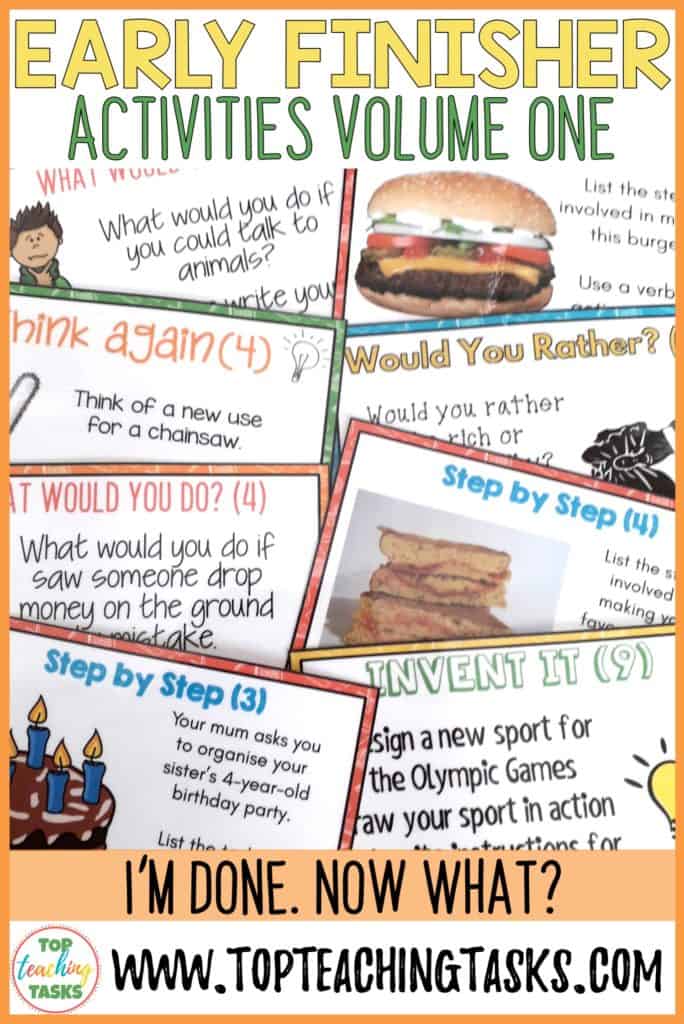
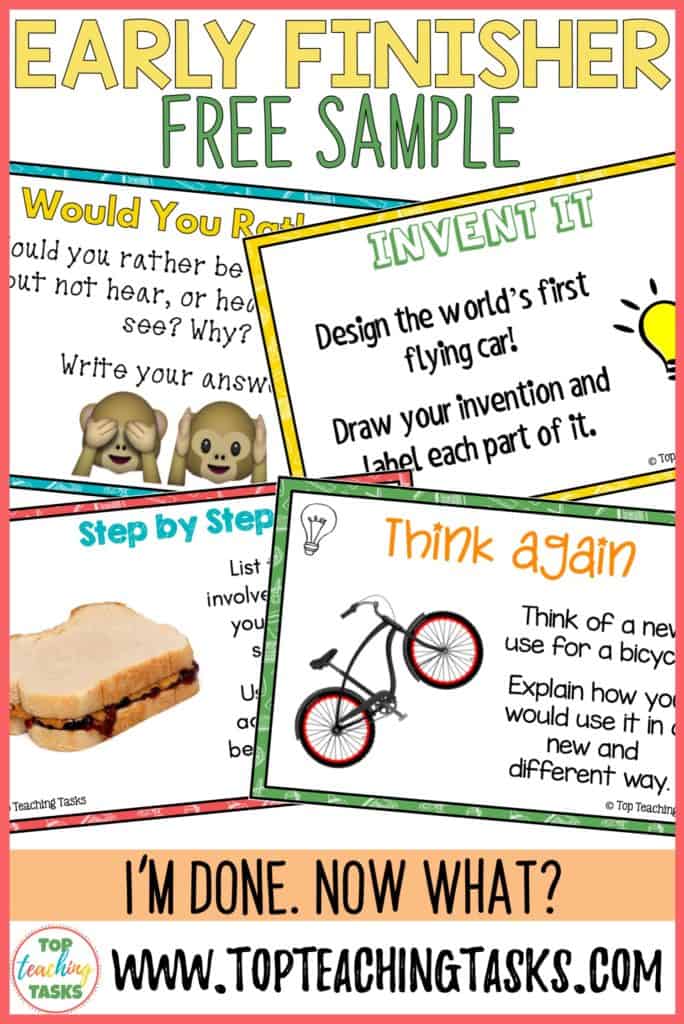
Early Finishers Activities are a must in your classroom. We have all heard the dreaded, “I’m Done, Now What?” Usually, it comes right when you are in the middle of working with a small group or testing a student – basically, right when you don’t need it. Read on to find the 5 must-haves of early finishers activities for your classroom.
My first experience with early finishers activities
I remember as a first-year teacher, I was still getting to grips with what my routines and structures would be, and I didn’t have anything in place for early finishers. When a student asked me what to do after they had finished, I did what I thought every teacher did, and said, “Go read a book.” What my students heard was, “Go and talk to your friends, be noisy and distracting, and muck around until everyone else has finished.”
What an amateur! Firstly, what a way to kill the joy of reading for a bunch of children, Hinemoa. Secondly, come on, get a bit creative!
The Problem With Early Finishers
For me, the problem areas with students who finish early are threefold:
1. Early finishers without purpose (apart from, “Go read a book”) are aimless and that isn’t what I want in my classroom. I want on-task students because bored kids get up to mischief!
2. Early finishers are likely to interrupt you to ask what they should do now that they are finished.
3. Early finishers who don’t know what to do next are dependent on the teacher, not building their own independence.
The four must-haves in early finishers activities
1. Easy to access and ready to use
One of the main points of a good early finisher activity is that students’ can use it without needing your help to do so. Therefore, it is vital that your activity/activities are set up somewhere where students can find them easily, e.g. a certain shelf or cupboard in the room. If the activity requires scissors, glue or other stationery, then make sure this is available and your students understand your expectations and routines.
This anchor chart by Fun in 5th Grade is a great way for the students to see visually what their early finisher activity options are. If they forget what the activities are, they know they can refer back to the anchor chart.
Once students understand what their activities are, where they go to get the activities, and what tools they need to complete the activities, they will be good to go!
2. Open-ended and reusable
As a teacher, you have enough on your plate without having to constantly create new early finishers activities. An early finisher activity, therefore, needs to be something that can be used over and over. Open-ended reading, writing, creative thinking, or research tasks with more than one possible outcome, answer or approach are perfect.
3. Meaningful and relevant
Every moment in the classroom should be a learning opportunity. With this in mind, early finishers activities are not busy work. A great early finisher activity will challenge and stretch students and build on skills that you are working on in the classroom. Ensuring that your early finishers activities are meaningful will also improve the chances of your students staying on task and produce work that they are proud of.
If you are looking for ideas for Maths Early Finishers activities, check out Teaching with Jennifer Findley. She has some great ideas.
4. Fun!
Early finishers activities should be more of a reward for finishing than a punishment. An important warning: you don’t want your activities to be so exciting that your students rush through their initial work to complete them. So put the candy floss machine away and hide the juggling balls, and let’s look at what I mean by fun. You can bring a sense of fun into activities by giving your students scenarios or questions that they aren’t usually asked at school.
For example:
Design the world’s biggest doughnut.
What would your day be like if you had eight arms?
Plan a trip to Disneyland. Research the rides you would like to go on and the costs involved.
I don’t know about your students, but from my experience, questions like this equal instant engagement!
Be ready when your students ask, “I’m done…now what?” Go paperless with our Early Finishers Digital Task Cards. These activities feature 21 interactive slides for students to work through. Due to their mostly open-ended nature, many slides can be used multiple times! See more here.
Creative Thinking Activity Cards
Another great activity for early finishers is our creative thinking activity cards. These could be used by individual students or a small group of early finishers.
Students use a mix of household items to solve a scenario card problem.
For example:
How could a watch, an umbrella and a wheelbarrow help rescue a cat stuck in a tree?
How could a basketball, a broom and a garden gnome help set a trap to catch a burglar? Use these Creative Thinking Activities to find out the answer (or should I say MANY possible creative answers!)
Learner Agency (also known as student agency) is key to providing opportunities for the development of key competencies and the application of learning. In this guest blog post, Kate Friedwald explores resources to support learner agency. Ensuring learners have a choice in their learning not only raises engagement but also supports the learning of vital…
In this blog post, I share with you how to use QR Codes as a Digital Reading Tool. I’ll also take you step-by-step through how to use a QR code and also explain how you can make your own. What are QR Codes? I am not going to attempt to explain that QR Codes are…
Research tells us that better listeners are better readers. We’ve put together this list of 10 Great Podcasts for Kids to highlight some excellent podcasts that provide active listening practice. Why Listen to Podcasts? Reading is a function of two key components: decoding and language comprehension. Listening is a key part of language comprehension. In…
To help with any teachers dealing with school closures or the possibility of home and distance learning, I’ve put together these Home Learning Choice Boards. If your school doesn’t close, these would still make great activity sheets in the school holidays. Thank you to the many teachers who collaborated by sharing their incredible ideas. It…
With many of us thrown into an unexpected period of distance learning, I wanted to highlight how my digital reading comprehension activities can help your students maintain and improve their reading skills. I’ve put together a free activity so you can trial Digital Reading Comprehension for Distance Learning. Let me unpack this free resource for…
5 Reasons to Use Primary Sources in the Classroom Primary sources carry a heavy reputation with them, conjuring ideas of dusty bookshelves, high school or university classes and translating from some ancient language. But primary sources are so much more than that – and can be a valuable tool for us to use in the…