Teaching Science, Social Sciences and Technology Through Literacy
If you’ve been reading through the refreshed Science, Social Sciences and Technology learning areas, you’ve probably had the same thought I did: how are we going to fit all of this in? The knowledge statements are far more detailed than before, and they are written as teaching requirements rather than achievement objectives. Schools will be required to start using Science and Social Sciences from 1 January 2027, and Technology follows for Years 0 to 8 from 1 January 2029.
The good news is that you don’t have to teach every learning area in its own separate block. A well-chosen text can carry curriculum knowledge and literacy teaching at the same time. That is exactly how our Whole-Class School Journal and Junior Journal resources are designed, and in this post I’ll show you how they line up with the new curriculum documents.
One Rich Text, Several Curriculum Areas, Five Days of Teaching
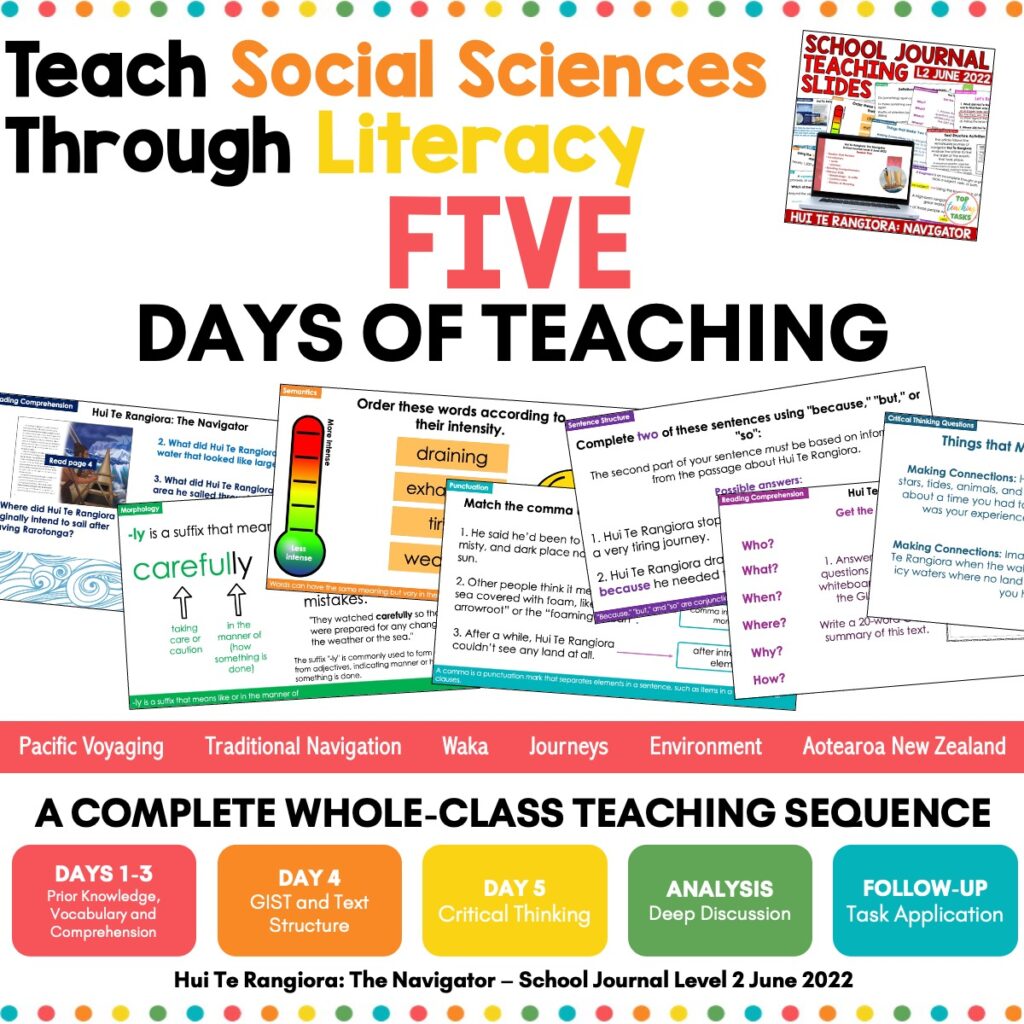
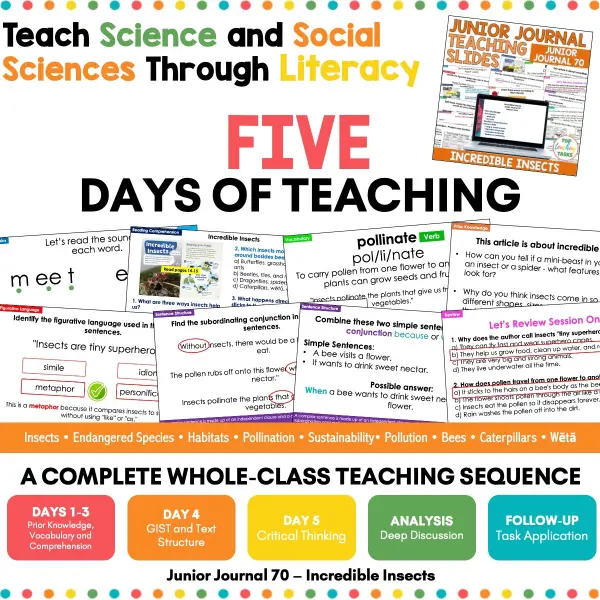
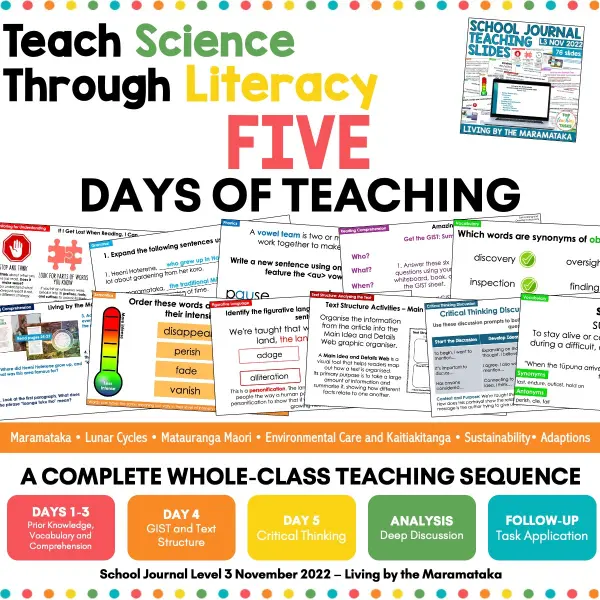
Each resource is built around one School Journal, Junior Journal or Connected article. Over five days, the whole class works with the same text. Students learn the curriculum content in the article while you explicitly teach vocabulary, comprehension, sentence structure, morphology and spelling using that same text.
- Days 1 to 3: Prior knowledge, vocabulary and comprehension
- Day 4: GIST summarising and text structure
- Day 5: Critical thinking
- Analysis: Deep discussion using structured prompts
- Follow-up: A task that applies the learning
Because every student reads the same text, everyone can take part in the discussion, including students who would usually be reading a different text in a group.
How the Resources Line Up with the Refreshed Curriculum
The refreshed Science and Social Sciences documents both organise the teaching sequence into knowledge (what to teach) and practices (the disciplinary skills students use). We have mapped every resource to both. For each text, we have identified:
- The exact knowledge statements. We use the curriculum’s own wording, along with the strand and year level, so you can see precisely which statements the text supports.
- A disciplinary practice. In Science, this is one of the four practices: Investigate, Evaluate, Communicate or Apply. In Social Sciences, it is one of the practices such as Think conceptually, Process information, Identify values and perspectives, or Communicate findings and conceptual knowledge.
- A graphic organiser that suits both the practice and the structure of the text, such as a sequence flowchart, a cause and effect chart, or a problem and solution chart.
- The literacy focus, including the spelling patterns, morphology, punctuation and sentence structures taught that week.
Here are a few examples of what that looks like.
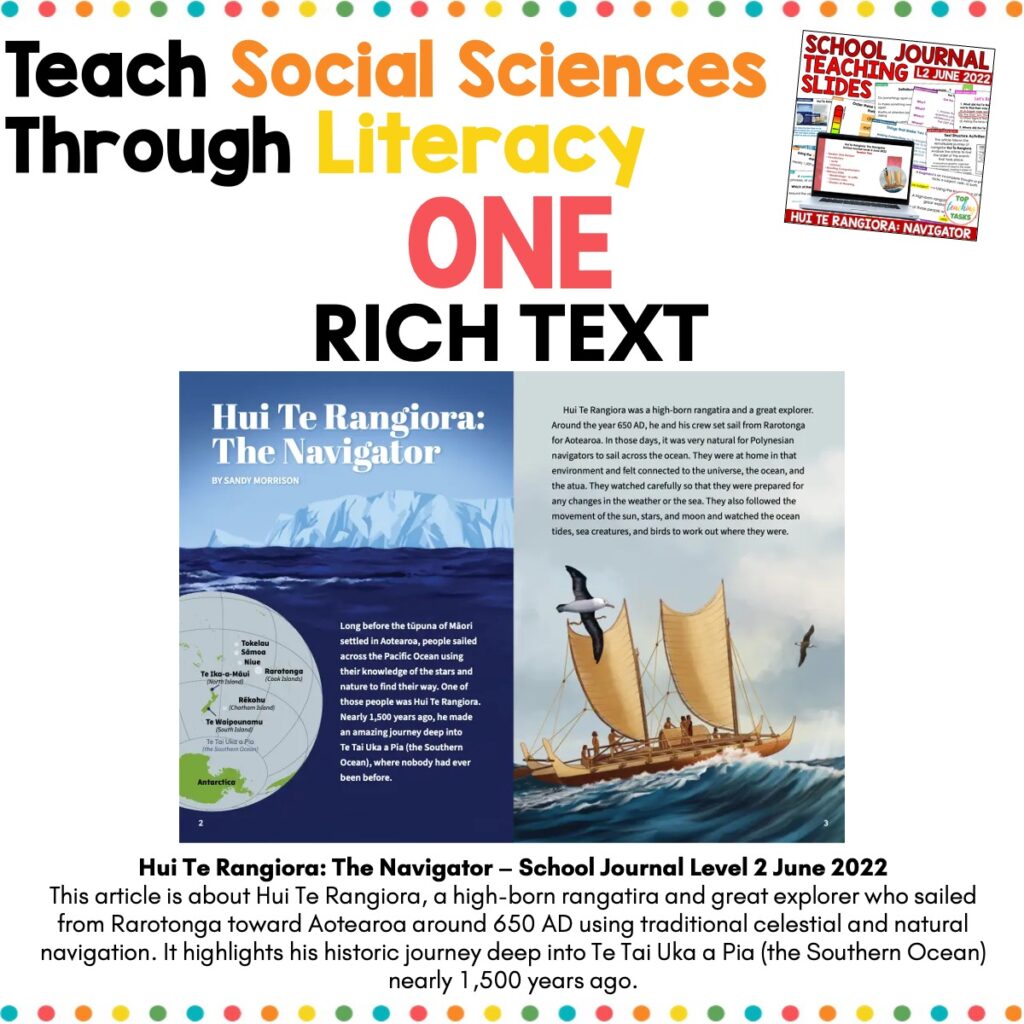
Hui Te Rangiora: The Navigator (School Journal Level 2, June 2022)

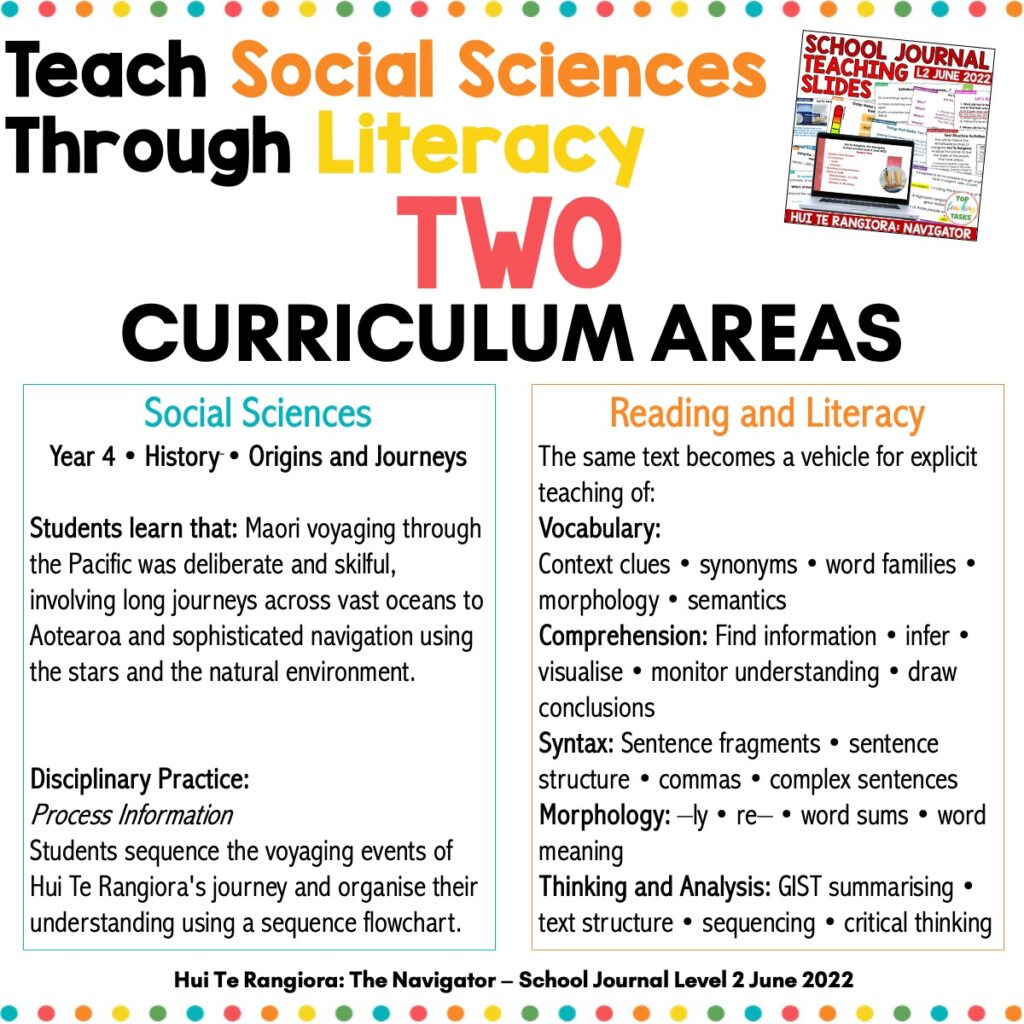
This article tells the story of Hui Te Rangiora, a high-born rangatira and great explorer who sailed from Rarotonga around 650 AD and travelled deep into Te Tai Uka a Pia (the Southern Ocean).
- Social Sciences: Year 4 History, Origins and Journeys. Students learn that Māori voyaging through the Pacific was deliberate and skilful, involving long journeys across vast oceans and navigation using the stars.
- Disciplinary practice: Process information. Students sequence the events of the voyage and organise their understanding using a sequence flowchart.
- Literacy: Sentence fragments, commas after introductory phrases, and the -ly and re- morphemes.
Incredible Insects (Junior Journal 70)
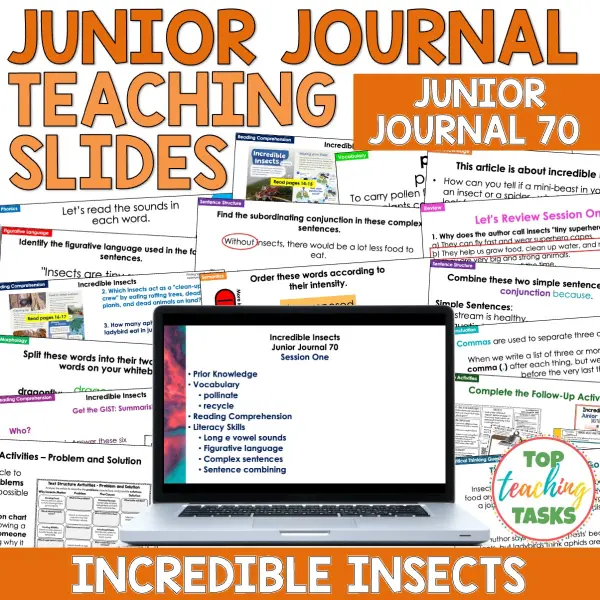
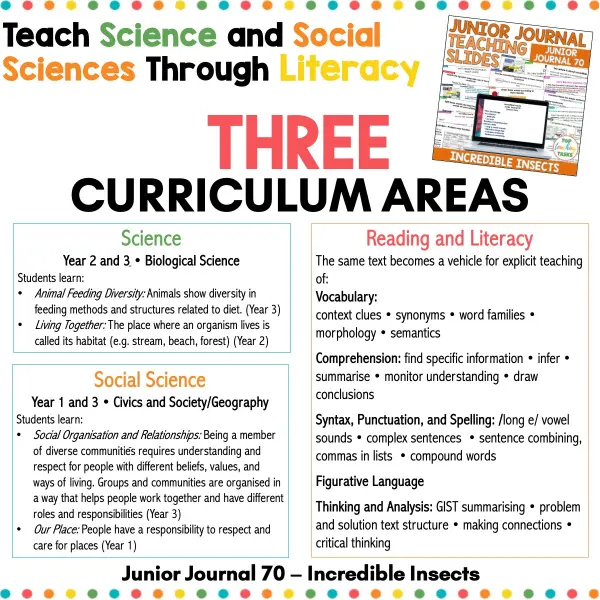
This one covers three curriculum areas at once.
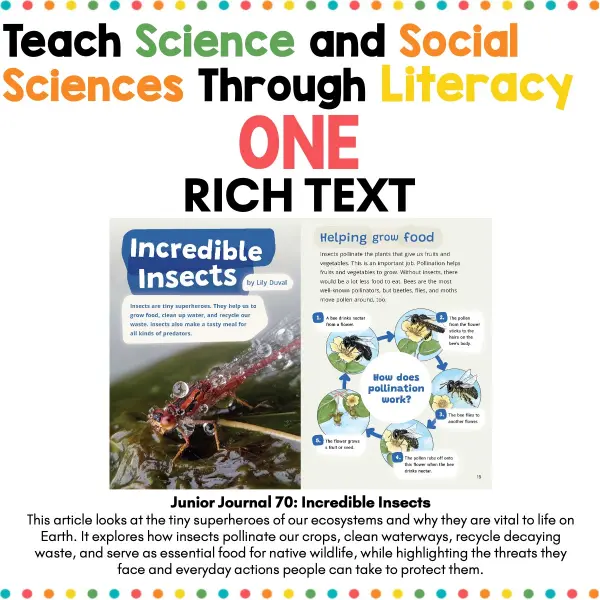
- Science: Year 2 and 3 Biological Science. Animals show diversity in feeding methods and structures related to diet, and the place where an organism lives is called its habitat.
- Social Sciences: Year 1 and 3 Civics and Society and Geography, including the idea that people have a responsibility to respect and care for places.
- Disciplinary practice: Students organise information about herbivores, carnivores and omnivores by relating body structures to the food they eat, and think about a shared project such as caring for a school garden.
- Literacy: Long e vowel sounds, complex sentences, sentence combining, commas in lists, compound words and figurative language.
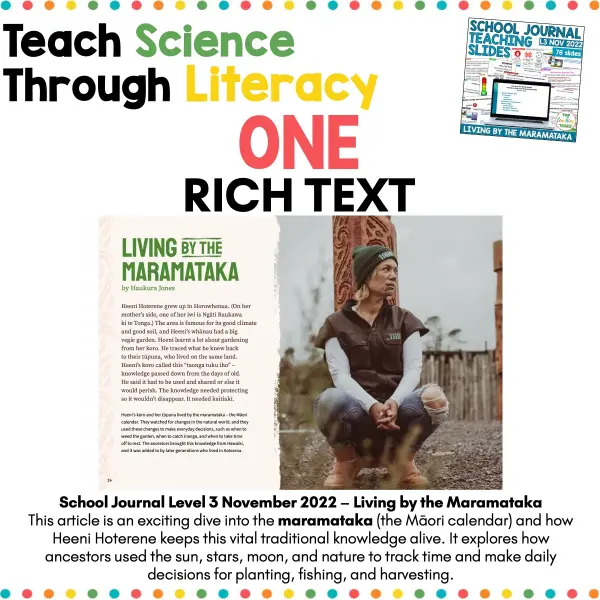
Living by the Maramataka (School Journal Level 3, November 2022)

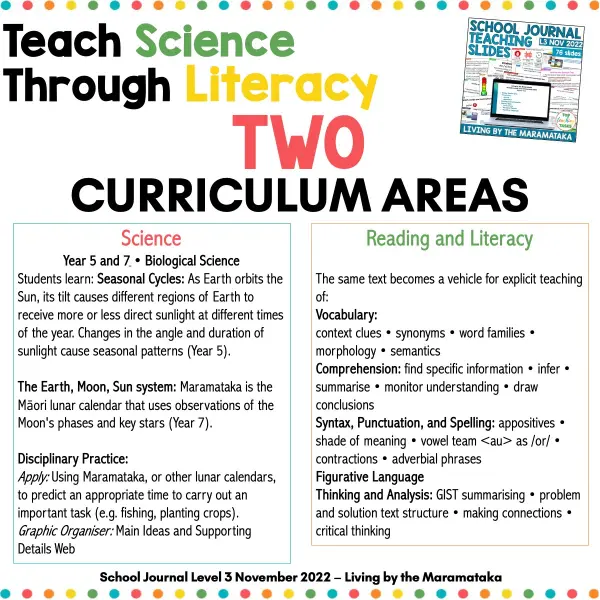
- Science: Year 5 and 7 Physical Science. Seasonal cycles, and the Maramataka as the Māori lunar calendar that uses observations of the Moon’s phases and key stars.
- Social Sciences: Year 3 History, Food and early Māori life, including how ancestral knowledge continues to be passed down and remains an important part of Māori life today.
- Disciplinary practice: Apply. Students use the Maramataka to predict a suitable time for an important task, such as fishing or planting crops.
- Literacy: Appositives, shades of meaning, the vowel team au, contractions and adverbial phrases.
What About Technology?
In Years 0 to 6, Technology is taught through one strand: Design, Make, and Innovate. Several of our texts give you a natural way in.
- Taking Off (Junior Journal 68) explores changes in transport technology, which links to the Year 5 idea that technology develops over time as ideas are modified to better meet user needs.
- The Future of Growing Kai (School Journal Level 2, November 2023) fits the Year 6 knowledge that technological outcomes reflect values and priorities, as seen in different approaches to food production such as hua parakore (kaupapa Māori organic farming) and hydroponic horticulture.
- Solar Power in Tokelau (Junior Journal 57) pairs well with investigating the inputs, controls and outputs of a simple system, such as a light circuit.


The reading and discussion give students the background knowledge they need before they start designing and making.
Resources for Every Phase
We have whole-class resources mapped across Phases 1 to 3. Here are some of them.
Phase 1 (Years 0 to 3)
- The Stars of Matariki (Science and Civics and Society)
- Incredible Insects (Science, Civics and Society, and Geography)
- Kūmara: Behind the Scenes (Science and Financial and Economic Activity)
- Spotting Kiwi (Science)
- Taking Off (Science and History)
- Solar Power in Tokelau (Science and Geography)
Phase 2 (Years 4 to 6)
- Hui Te Rangiora: The Navigator (History)
- Living by the Maramataka (Science and History)
- The Future of Growing Kai (Science and History)
- Daylighting Streams (Geography)
Phase 3 (Years 7 to 8)
- Keeping Promises: The Treaty Settlement Process (Civics and Society and History)
- Cage Diving with Sharks (Science and Civics and Society)
Making the Most of Your Teaching Time
Rich, knowledge-filled texts do more than tick off curriculum statements. The more students know about a topic, the better they understand what they read, so every article builds the background knowledge that supports their reading comprehension. At the same time, you are teaching the literacy skills grounded in the Science of Reading and Structured Literacy approaches.
One text, one week, several learning areas. That is time back in your timetable.
Browse our full range of Whole-Class Teaching Resources
Top Teaching Tasks Membership

Have you heard of our Top Teaching Tasks Membership? Instead of spending hours searching for the perfect worksheet, you can get access to thousands of ready-to-use resources in one place.
Our teacher-approved membership gives you:
- Unlimited downloads of premium resources
- Fresh, exciting content added monthly
- Exclusive member-only materials
- Freedom to cancel anytime
So, what are you waiting for? Sign up for a Top Teaching Tasks membership and simplify your lesson planning today.