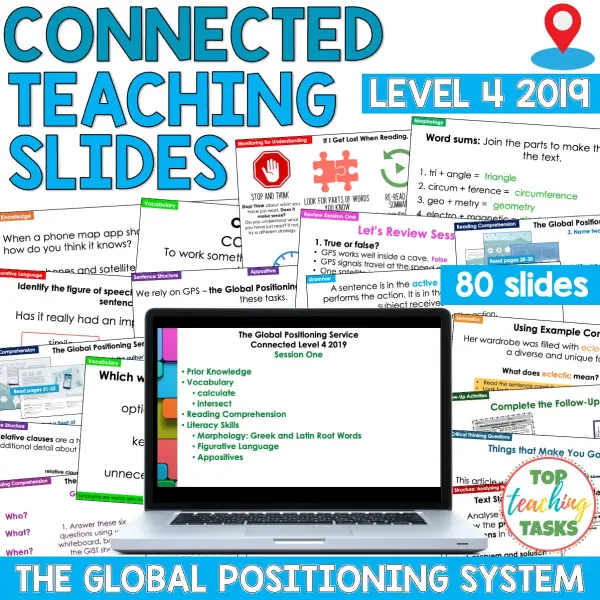
The Global Positioning System Whole Class Teaching Slides – Connected Level 4 Years 7–8
NZ$8.50
Description
How does your phone know exactly where you are? Your students use GPS every day, but few know how it works or what happens when it fails.
This ready-to-teach activity pack is built around “The Global Positioning System” by Renata Hopkins (Connected Level 4, 2019). The article explains how a network of satellites and a mathematical principle called trilateration pinpoint a location. It shows how communities rely on GPS, from farming to emergency services. It also looks at what can go wrong, including the 2016 satellite error and deliberate jamming and spoofing. Students learn to question how much we should depend on technology: “Use your tech – and your head”.
Over five lessons, students build vocabulary, comprehension and critical thinking. They also learn explicit grammar, morphology and figurative language skills drawn from the Year 7–8 English teaching sequence. There is also direct alignment to the refreshed Technology curriculum.
Inside the pack
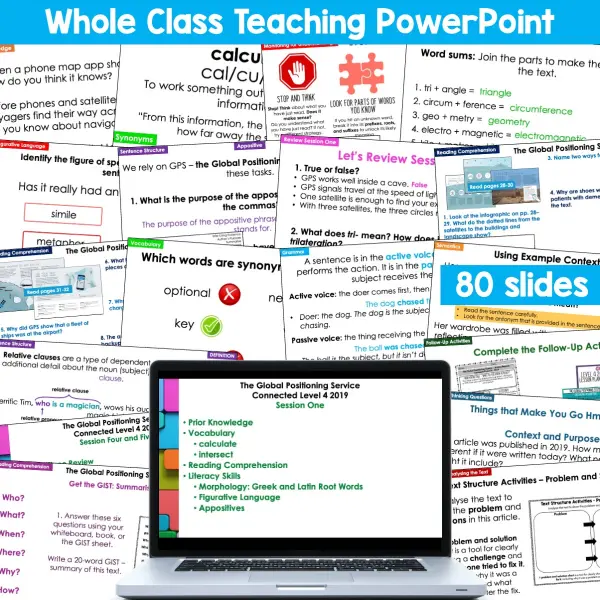
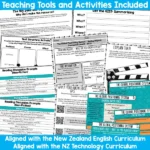
- An 89-slide PowerPoint (confirm the final count).
- Three reading sessions over three days:
- Session One: pp. 25–27.
- Session Two: pp. 28–30.
- Session Three: pp. 31–32.
- Six Tier 2 vocabulary words: calculate, intersect, essential, rely, deliberate and consequence. Each word includes a syllable breakdown, kid-friendly definition, part of speech, synonyms, antonyms and a line from the article. Each is followed by synonym checks, correct-usage multiple choice and Think–Pair–Share or application tasks.
- Reading comprehension each session: a monitoring-for-understanding prompt, then questions on finding specific information, inferring using evidence, interpreting diagrams and infographics, summarising and drawing conclusions. Separate answer slides are included.
- A review of the previous session at the start of Sessions Two and Three.
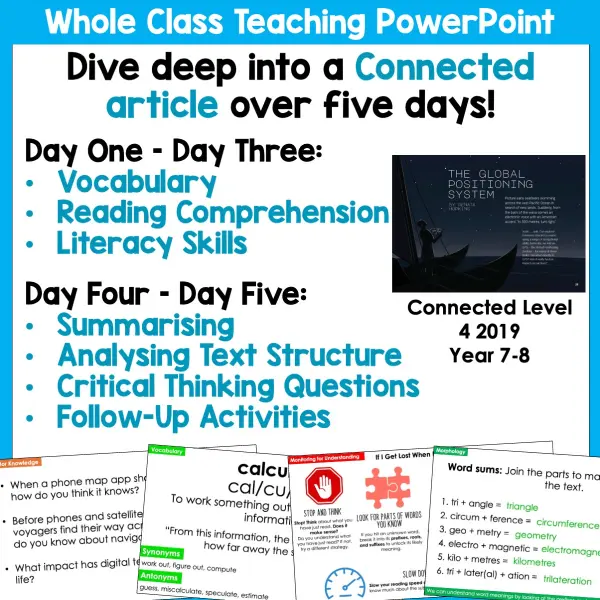
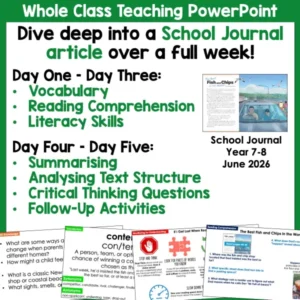
- Days 4 and 5:
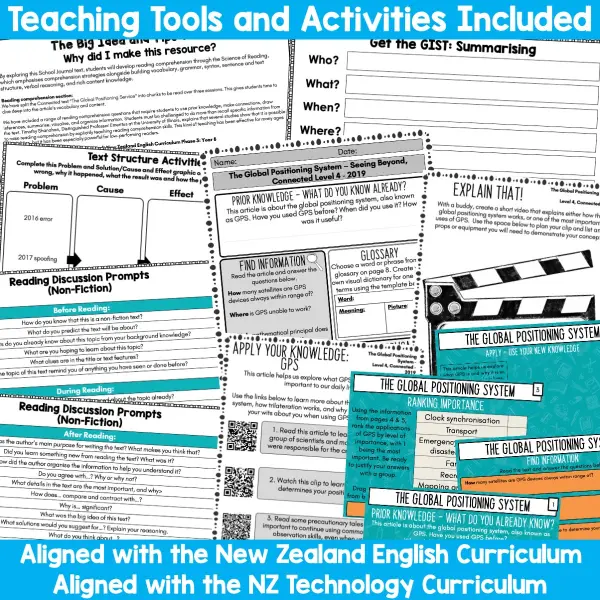
- Get the GIST: six questions and a 20-word summary.
- Text structure: a cause and effect/problem and solution organiser with answers.
- “Things that Make You Go Hmmmm…”: critical thinking and discussion prompts
- Digital and print follow-up activities.
Literacy skills taught
Every skill is taught with sentences quoted from the article, then practised through several activities with worked answers.
- Session One:
- Morphology: Greek and Latin word parts (for example tri-, geo-, circum- and electro-), through word sums and building words.
- Figurative language: rhetorical questions, and explaining the effect of the author’s choices (“Yeah . . . nah.”, “put you on the map”).
- Appositives: identifying, punctuating and combining sentences with them.
- Session Two:
- Active and passive voice: identifying and rewriting sentences.
- Figures of speech.
- Context clues
- Session Three:
- Relative clauses: identifying them and choosing between who, whose, which, where, when and why.
- Sentence construction: combining sentences with relative clauses.


THIS RESOURCE, AND OUR FULL RESOURCE RANGE IS ALSO AVAILABLE IN OUR TOP TEACHING TASKS MEMBERSHIP.
FIND OUT MORE HERE.
You may also like…


Related products
-
Sale!


Digital Writing Prompts Bundle for Google Drive®
Original price was: NZ$20.00.NZ$16.00Current price is: NZ$16.00. -

-
-


