
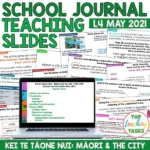
Whole Class School Journal Resource Year 7-8 – Kei te Tāone Nui: Māori and the City 1945-1970
NZ$8.50
Description
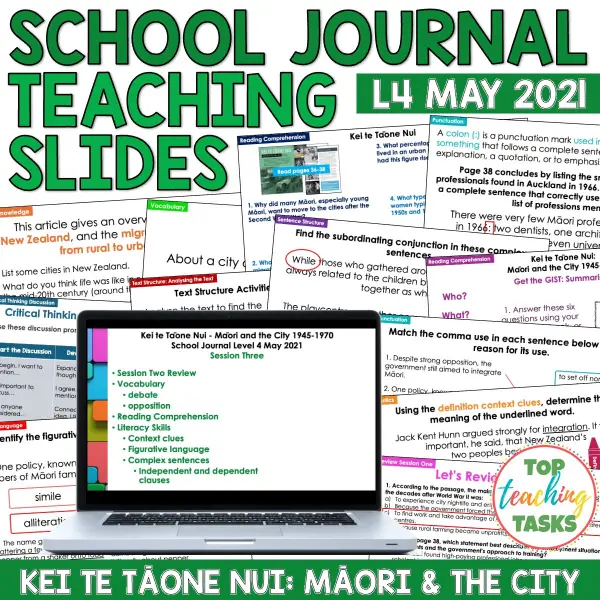
Enhance your students’ reading comprehension and knowledge of NZ history content with this comprehensive resource, focused on Kei te Tāone Nui – Māori and the City 1945-1970 from the Level 4 May 2021 School Journal. This teaching tool is great as an addition to your structured literacy program.
It engages students in deep comprehension strategies, vocabulary building, grammar, syntax, sentence structure, verbal reasoning, and content knowledge—key elements of the Science of Reading approach.
Kei te Tāone Nui – Māori and the City 1945-1970 from School Journal Level 4 May 2021. This article details the large-scale migration of Māori to New Zealand cities after World War II, seeking economic opportunities, and the significant prejudice they faced. It further explores how Māori responded by strengthening cultural communities, which fostered collective action and laid the groundwork for the modern Māori protest movement.
How It Works:
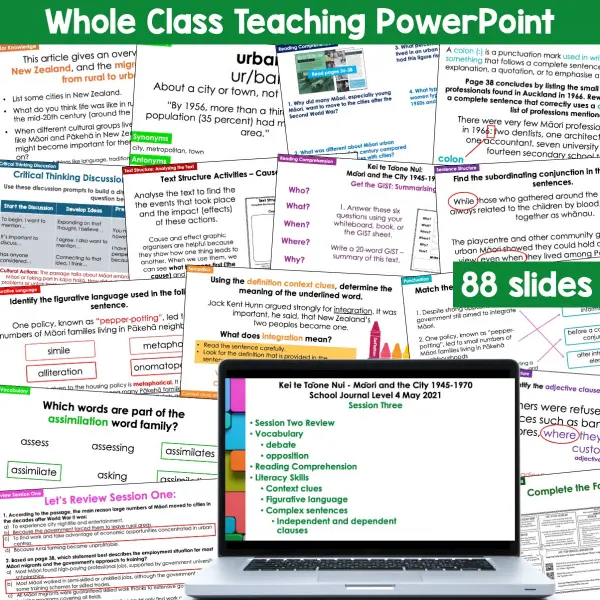
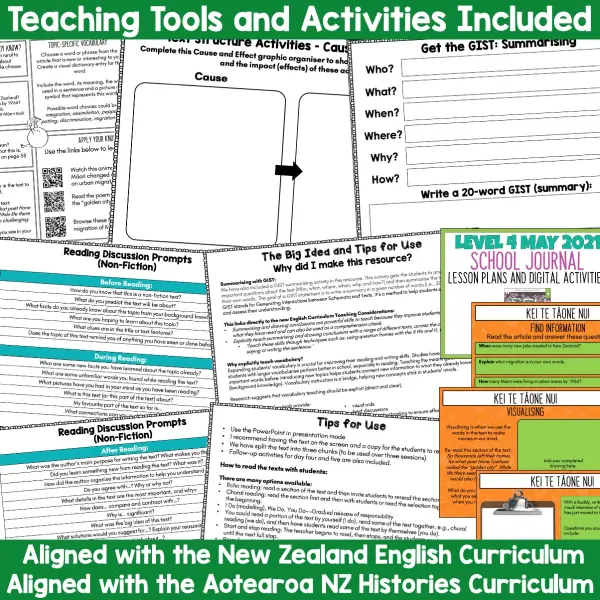
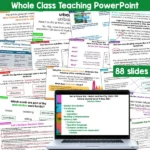
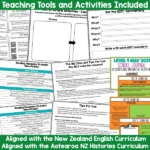
This resource is designed for whole-class teaching. You receive a slideshow with 88 slides, additional support worksheets, and graphic organisers.
- Simply display the School Journal PDF on your projector or TV screen and distribute copies of the text between 2-3 students. With the slides in Presenter View, you’ll have everything you need for a successful lesson—just click and go!
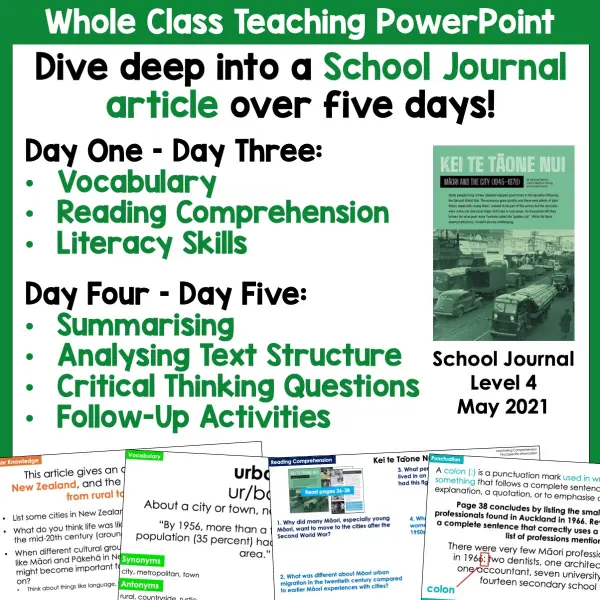
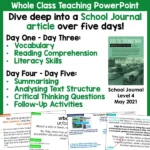
- The resource divides the text into three manageable chunks to be read over three sessions, allowing plenty of time to dive deep into the vocabulary and content of the article.
- Along with the text, we’ve included a set of discussion prompts to get your students talking and thinking critically about what they’re reading.
On days four and five, explore the text further with:
- A GIST summarising activity
- A text structure analysis graphic organiser (cause and effect)
- Critical thinking questions to encourage deeper connections and inferences.
Key Features:
- Focus on monitoring comprehension, summarising, drawing conclusions, and using evidence.
- Clear links to the Aotearoa New Zealand Histories Curriculum for Year 7-8
- Comprehension activities that require students to do more than recall specific information.
- Literacy activities that link to key writing skills
- adjective phrases
- sentence expanding using ‘because, but, so’ conjunctions
- complex sentences
- commas rules
- colons
- context clues
- figurative language
- A GIST summarising activity, helping students condense the text into a 20-word summary, improving both their understanding and memory.
- A cause and effect graphic organiser to analyse the structure of this text.
- Explicit vocabulary instruction with definitions, examples, and semantic activities such as synonyms and antonyms.
- Critical thinking questions to dig deeper and encourage discussion.
- Activities that focus on comprehension, summarising, and using evidence to make inferences.
Benefits of This Resource:
- Promotes active learning and student engagement with a combination of reading, discussion, and critical thinking activities.
- Designed to build vocabulary and improve comprehension strategies, making it ideal for a wide range of learners, including lower-level readers.
- Helps students connect the text and their own experiences, deepening their understanding of the material.
This resource supports teaching students how to:
- Monitor and confirm comprehension by annotating, rereading, asking, answering questions, and visualising.
- Summarise and draw conclusions, identifying key details supporting the text’s main message.
- Make inferences using stated and implied ideas, drawing from prior knowledge.
- Analyse text structure and the language used for effect with a text
- Think critically about a text by analysing perspectives and making connections.
Clear links to the Aotearoa New Zealand Histories Curriculum:
Whakapapa me te whanaungatanga | Culture and identity
Urbanisation and being Māori
Mid twentieth-century Māori migration to New Zealand cities occurred at an unprecedented pace and scale, disrupting the whakapapa of te reo and tikanga and depopulating papa kāinga. New approaches to being Māori and retaining iwi values and practices were created and debated. Movements to reassert Māori language, culture, and identity arose throughout the country.
- What were the challenges Māori faced after the Second World War?
- What do hapū and iwi say about their relocation to the cities and the reasons for it?
- What has this meant for their identity as Māori?
Tips for Use:
- Use the PowerPoint in presentation mode for easy, seamless delivery.
- Display the text on the screen and give students a copy to read together in pairs or small groups.
- Follow the suggested activities over three sessions, with additional follow-up activities on days four and five to extend learning.
Why Choose This Resource?
Perfect for educators looking to improve their students’ reading comprehension and vocabulary skills while growing prior content knowledge and aligning with English and Social Sciences curriculum objectives!


THIS RESOURCE, AND OUR FULL RESOURCE RANGE IS ALSO AVAILABLE IN OUR TOP TEACHING TASKS MEMBERSHIP.
FIND OUT MORE HERE.
You may also like…
-
Sale!


Daily Literacy Reviews For Year 7-8 Bundle
Original price was: NZ$80.00.NZ$65.00Current price is: NZ$65.00. -


-


-


Related products
-
Sale!

Phonics and Spelling Rules Bundle Year 1-8 – Structured Literacy Activities
Original price was: NZ$37.50.NZ$29.99Current price is: NZ$29.99. -
Sale!


Digital Writing Prompts Bundle for Google Drive®
Original price was: NZ$20.00.NZ$16.00Current price is: NZ$16.00. -

-


