Early Whalers and Sealers – A Knowledge-Rich NZ History and Literacy Unit Phase 2
NZ$8.50
Description
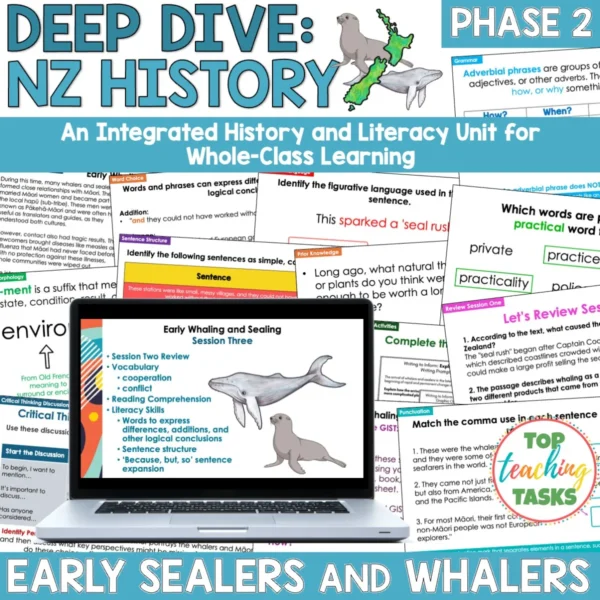
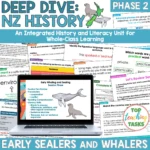
Develop your students’ history content knowledge, reading comprehension, writing, and literacy skills with this comprehensive whole-class teaching resource, centered around early whalers and sealers in New Zealand.
This resource is a perfect addition to your structured literacy program. It offers rich historical content and effective learning strategies.
This teaching tool engages students through the principles of the Science of Reading, focusing on:
-
Deep comprehension strategies
-
Vocabulary building
-
Grammar and syntax
-
Sentence structure
-
Verbal reasoning
-
Content knowledge
Immerse your students in a key historical event while developing their reading, writing and literacy skills, and fostering a deeper understanding of Aotearoa New Zealand’s past.
How It Works:
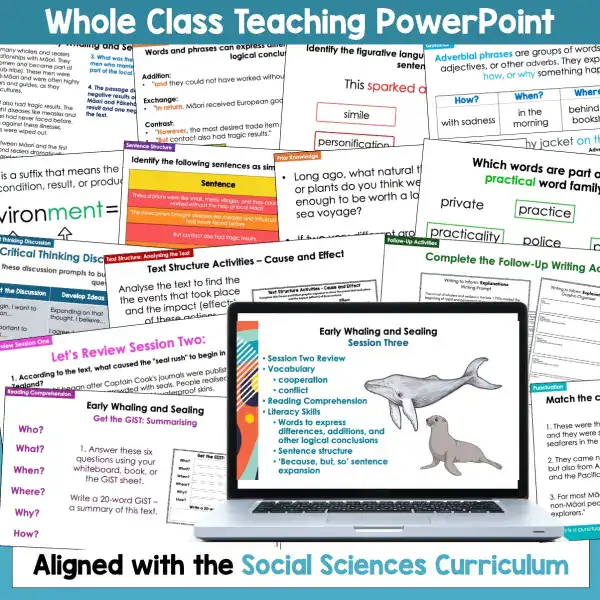
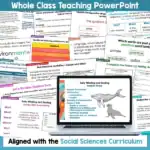
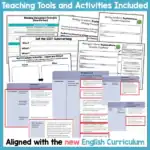
This resource is designed for whole-class teaching. You receive a slideshow with 75 slides, additional support worksheets, and graphic organisers.
-
Simply display the teaching slides on your projector or TV screen and distribute copies of the text between 2-3 students. With the slides in Presenter View, you’ll have everything you need for a successful lesson—just click and go!
-
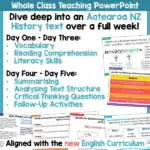
The resource divides the text into three manageable chunks to be read over three sessions, allowing plenty of time to dive deep into the vocabulary and content of the article.
-
Along with the text, we’ve included a set of discussion prompts to get your students talking and thinking critically about what they’re reading.
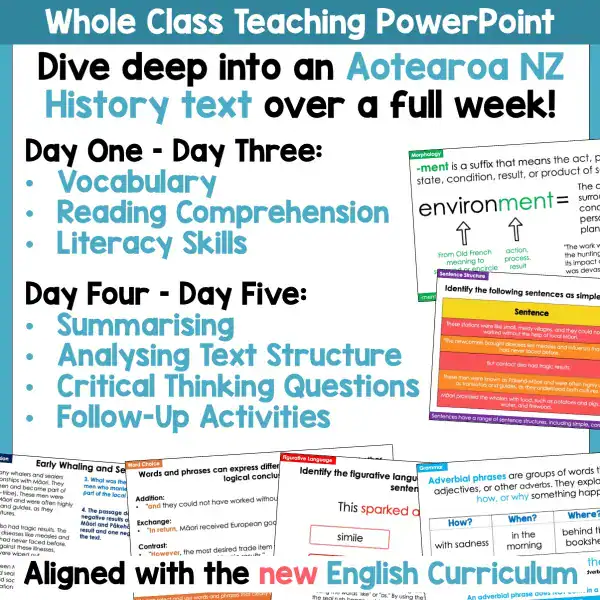
On days four and five, explore the text further with:
-
A GIST summarising activity
-
A text structure analysis graphic organiser (cause and effect)
-
Critical thinking questions to encourage deeper connections and inferences.
Key Features:
-
Focus on monitoring comprehension, summarising, drawing conclusions, and using evidence.(aligns to the New Zealand English Curriculum for Year 5 and 6 students).
-
Comprehension activities that require students to do more than recall specific information.
-
Literacy activities that link to key writing skills
-
compound and complex sentences
-
sentence combining
-
sentence expanding
-
morphology
-
figurative language
-
comma rules
-
-
A GIST summarising activity, helping students condense the text into a 20-word summary, improving both their understanding and memory.
-
A Cause and Effect text structure graphic organiser to analyse the structure of this text.
-
Explicit vocabulary instruction with definitions, examples, and semantic activities such as synonyms and antonyms.
Benefits of This Resource:
-
Promotes active learning and student engagement with a combination of reading, discussion, and critical thinking activities.
-
Designed to build vocabulary and improve comprehension strategies, making it ideal for a wide range of learners, including low-performing readers.
-
Helps students make connections between the text and their own experiences, deepening their understanding of the material.
-
Students learn about key moments in Aotearoa New Zealand History
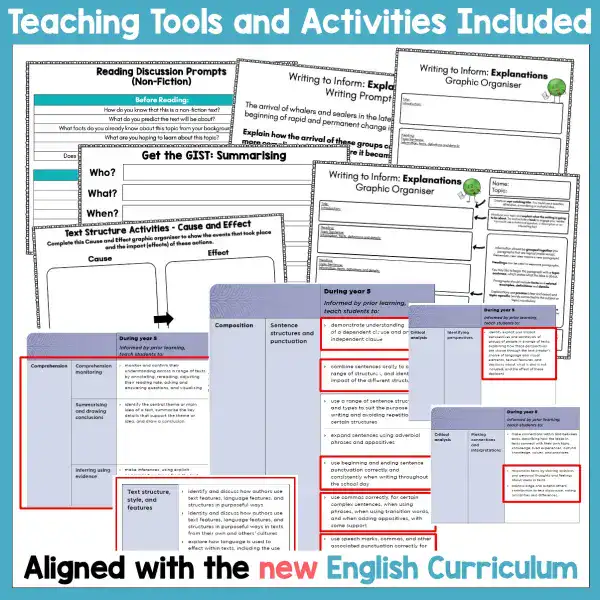
Aligned with the New Zealand English Curriculum for Phase Two – During Year 6: This resource supports teaching students how to:
-
Monitor and confirm comprehension by annotating, rereading, asking, answering questions, and visualising.
-
Summarise and draw conclusions, identifying key details supporting the text’s main message.
-
Make inferences using stated and implied ideas, drawing from prior knowledge.
-
Analyse text structure and the language used for effect with a text
-
Think critically about a text by analysing perspectives and making connections.
Aligns with the Aotearoa New Zealand Histories and Social Sciences Curriculums for Year 4-6:
Year 4-6: Ngā ahurea me te tuakiri kiritōpū | Culture and collective identity
-
The stories of groups of people from different periods in our history convey their reasons for and experiences of migration. These stories have shaped their culture and identity in Aotearoa New Zealand.
Year 4-6: Te tūrangawaewae me te taiao | Place and environment
-
People interact with places, resources, and environments for personal, social, cultural, economic, and spiritual reasons.
-
People’s actions can have long-term positive and negative environmental impacts on places, the people who live in them, and the wider world.
-
People adapted their technologies and tools to the new environment of Aotearoa New Zealand.
Year 4-6: Kōwhiringa ohaoha me te whai oranga | Economic activity
-
Traditional Māori economies were finely tuned to the resources within each rohe, which provided the basis for trade between iwi.
-
There were complicated economic relationships between iwi and early newcomers as newcomers sought resources.
-
Explore examples of economic relationships between coastal iwi and early newcomers such as sealers, whalers, and traders.
Tips for Use:
-
Use the PowerPoint in presentation mode for easy, seamless delivery.
-
Display the text on the screen and give students a copy to read together in pairs or small groups.
-
Follow the suggested activities over three sessions, with additional follow-up activities on days four and five to extend learning.


THIS RESOURCE, AND OUR FULL RESOURCE RANGE IS ALSO AVAILABLE IN OUR TOP TEACHING TASKS MEMBERSHIP.
FIND OUT MORE HERE.
You may also like…
-
-
-


-
Sale!


New Zealand History Reading Bundle | NZ School Journal Time Travel Adventure Level 2-4
Original price was: NZ$84.00.NZ$66.99Current price is: NZ$66.99.