



Whaling and Sealing in New Zealand: A History Mystery Scavenger Hunt Activity
NZ$7.50
Description
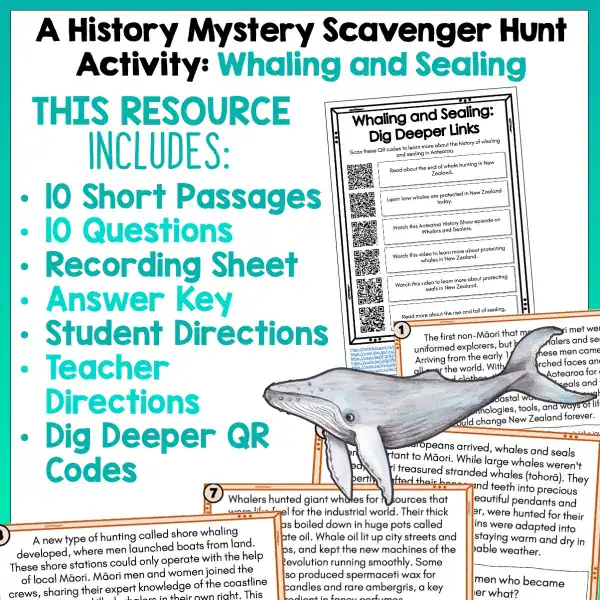
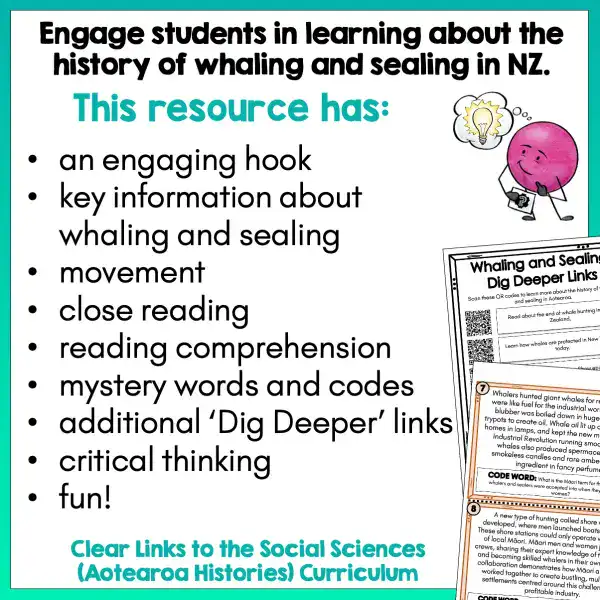
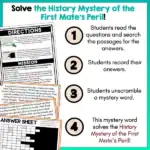
The Whaling and Sealing in New Zealand Scavenger Hunt is an engaging cross-curriculum reading comprehension activity. Allow your students to move around the room, visit reading passages and answer questions. Solve the mystery of the First Mate’s Peril!
The task card scavenger hunt is designed so students must visit/read each of the ten fact cards! That means they must read the passage or skim for details multiple times!
Students will use nonfiction social studies content to practice reading skills, improve fluency and comprehension, and use context clues.
This is an engaging way to hook students into a study of the history of whaling and sealing in New Zealand, or as part of a unit on migrants to New Zealand.
This scavenger hunt has TWO components:
- Part 1: Students will read ten short passages revealing the question of their next “clue” or code word. After finding each code word, students must write them on their answer sheet.
- Part 2: Using the code word on each clue card, students unscramble the letters in the grey-shaded boxes to reveal the final word.
Individuals, pairs, or groups of students could do this activity.
In this Whaling and Sealing in New Zealand Scavenger Hunt pack, you will receive:
1. Ten Fact Cards about Whaling and Sealing in New Zealand
2. Directions and Mission sheet
3. Student answer sheets
4. Teacher answer key
5. Dig Deeper QR Code Links: Whaling and Sealing in NZ
Links to the Social Sciences Curriculum:
Year 4-6: Ngā ahurea me te tuakiri kiritōpū | Culture and collective identity
- The stories of groups of people from different periods in our history convey their reasons for and experiences of migration. These stories have shaped their culture and identity in Aotearoa New Zealand.
Year 4-6: Te tūrangawaewae me te taiao | Place and environment
- People interact with places, resources, and environments for personal, social, cultural, economic, and spiritual reasons.
- People’s actions can have long-term positive and negative environmental impacts on places, the people who live in them, and the wider world.
- People adapted their technologies and tools to the new environment of Aotearoa New Zealand.
Year 4-6: Kōwhiringa ohaoha me te whai oranga | Economic activity
- Traditional Māori economies were finely tuned to the resources within each rohe, which provided the basis for trade between iwi.
- There were complicated economic relationships between iwi and early newcomers as newcomers sought resources.
- Explore examples of economic relationships between coastal iwi and early newcomers such as sealers, whalers, and traders.
Year 7-8: Ngā ahurea me te tuakiri kiritōpū | Culture and collective identity
- People can experience inclusion or exclusion in different situations, which has consequences for them and for society.
- Over time people from a wide range of cultures have participated in and contributed to Aotearoa New Zealand, while retaining and adapting their distinctive identities. The histories of Chinese, Indian, and other Asian communities, Pacific communities, refugee and faith-based communities, disability communities, and the Deaf community demonstrate how this has been experienced. Some have met barriers.


THIS RESOURCE, AND OUR FULL RESOURCE RANGE IS ALSO AVAILABLE IN OUR TOP TEACHING TASKS MEMBERSHIP.
FIND OUT MORE HERE.
You may also like…



Related products
-
-


-
Sale!


Digital Season Writing Prompts BUNDLE
Original price was: NZ$20.00.NZ$16.00Current price is: NZ$16.00. -