The Promise – School Journal Level 4 May 2015
In this story, five kids in a bunker have a crucial decision to make.

In this story, five kids in a bunker have a crucial decision to make.

Si’aula, a young girl of mixed Samoan and Pālagi heritage, struggles with her identity and the teasing she receives for her striking green eyes. While her mother embraces their Samoan culture, Si’aula feels “mixed up” and embarrassed by her family’s traditions, such as her grandmother’s insistence on covering mirrors at night to hide from spirits….

In this article, the life of an important Māori leader, Hakaraia, is remembered.

Extreme cavers Marcus Thomas and Neil Silverwood lead a team deep into the belly of Mount Owen to prove a mind-boggling theory: that a hidden waterway connects the south and north sides of the mountain. By tracking a fluorescent-green dye through the freezing, labyrinthine passages of Bulmer Cavern, the explorers risk a grueling five-day underground…
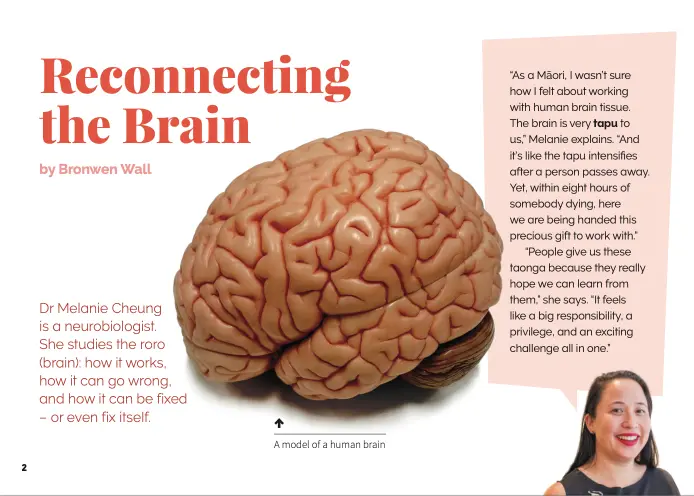
Dr Melanie Cheung is a neurobiologist. She studies the roro (brain), collecting and analysing data about how it works and what can go wrong. She also studies the use of tikanga (Māori customary practices) in the modern science world.
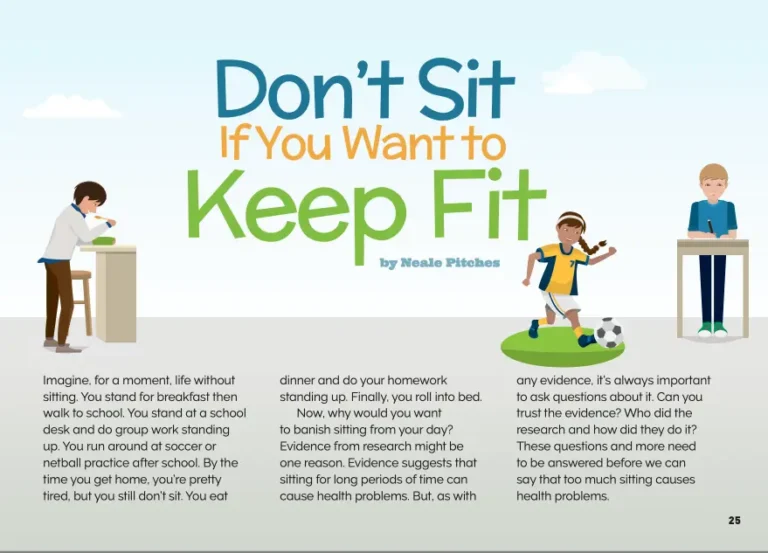
Scientific evidence suggests that sitting for long periods of time can cause health problems and that standing and moving around is better for us. But as with any scientific evidence, we need to ask questions about the evidence to determine if it can be trusted.
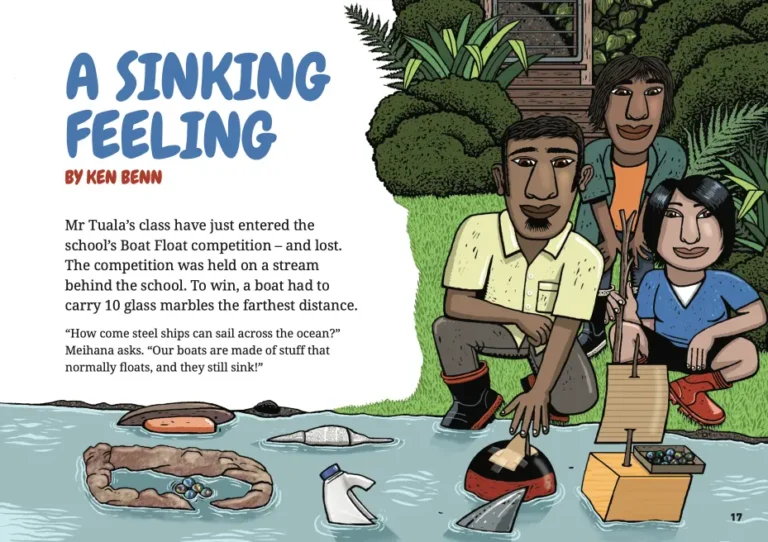
Mr Tuala’s class have lost the Boat Float competition and they want to figure out why. By learning more about density (and how it relates to floating a boat), they critique their original boat designs and use what they have learned to design and build new, more successful boats.

When Tokelau decided to switch to renewable energy, they thought critically about all the options. They decided that solar energy was a cost-effective option suited to the sunny Tokelaun climate.

Close to the Edge, the 2014 Elsie Locke Writing Prize winner by student Cecile Kruger, is a post-apocalyptic story about a girl named Opal and her mother fleeing a city choked by toxic smoke. .

Ashleigh Young poetically describes embarrassment using figurative language, and how to become an expert.

Fair Chocolate is an article that explains how a Christchurch-based fair-trade company established its own organic chocolate factory to ensure more direct and ethical partnerships with cacao farmers in the Dominican Republic. The article details the complex transition from European manufacturing to local New Zealand production, highlighting the “real cost” of goods and the importance…

This article explores the New Zealand Wars, a series of 19th-century conflicts between Māori tribes and the British Empire fought over land ownership and national control. It details key military campaigns, including the Northern, Taranaki, and Waikato wars, highlighting the strategic use of Māori pā and the rise of the Kingitanga movement. The narrative examines…

Battle is a high-energy story about Timiona, a Year 7 student who secretly borrows his great-great-grandfather’s war medal to give him courage during a school krumping competition. While Timiona manages to win the dance battle through skill and confidence – even after realising his hoodie and the medal have gone missing – he eventually discovers…

Set in colonial New Zealand, this historical story follows Thelma, a young settler adjusting to a new life while befriending a Māori boy named Tama. Through their friendship, Thelma learns about native flora and traditional remedies, documenting her discoveries in a journal alongside a list of potential names for her mother’s unborn baby. The narrative…

This tale of a boy telling his grandfather about a cricket match sounds simple, but the clever text structure and extensive use of the language of cricket makes it a very rich text that can be revisited many times for different purposes. The theme of relationships between the generations is conveyed powerfully and in ways…

Inside this School Journal there are four stories (Match Report; Kauri Island; Battle; and Close to the Edge), two articles (Ngā Pakanga o Aotearoa – The New Zealand Wars and Fair chocolate) and one poem (The Embarrassment Expert).
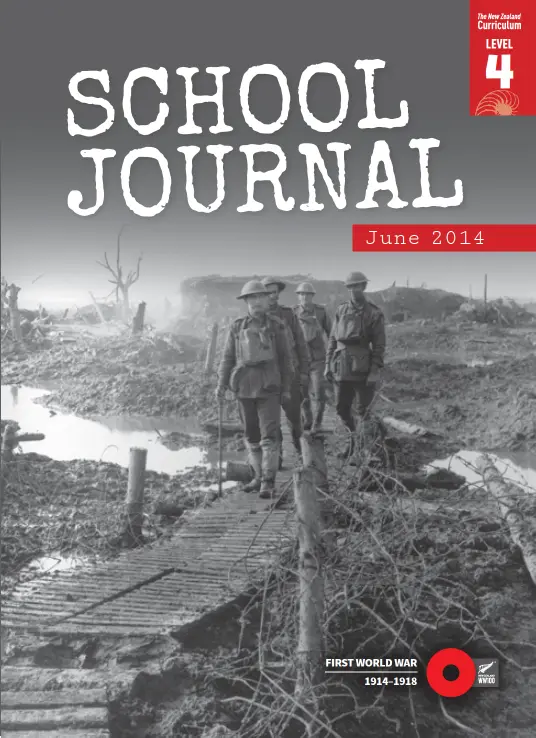
Inside the School Journal Level 4 June 2014 are two stories (King and Country; Sky-high), one poem (Dawn Service), and three articles (Underground Soldiers; Lest We Forget; and The Children’s War).

This graphic novel/comic tells the personal story of a miner from Waihi who served in the New Zealand Tunnelling Company. Stationed near Arras, the company spent months in a “game of cat and mouse,” using geophones to monitor German counter-mining while digging tunnels and expanding ancient quarries into a secret underground city.

This fictionalised story is based on the controversial issue of Māori fighting for the British Empire during the First World War. Students will need some knowledge about the history of our race relations and, in particular, the colonisation of Aotearoa by the British.

A poetic story about memories of a great-granddad who flew in World War One.

This article details the New Zealand Tunnelling Company’s efforts during the First World War. Arriving in Arras in 1916, these miners and laborers converted ancient quarries into a secret underground city for 25,000 troops, complete with a hospital and electric lighting. Using geophones to monitor enemy “counter mining,” they prepared a massive surprise attack for…

This article explores how oral history preserves the lived experiences of First World War veterans to counter “national amnesia” regarding the conflict. Through eighty-five recorded interviews now held at the Alexander Turnbull Library, historians captured the shift from initial “adventure” to the grim realities of Gallipoli, the Somme, and shell shock. These “eye witness” accounts…

This article describes how New Zealand children were mobilised as “little crusaders” to support the British Empire through school rituals and the School Journal. While soldiers faced the horrors of Gallipoli and Passchendaele, children at home were taught duty through flag saluting, military drills, and extensive fundraising for the war effort. This era left a…

Te Papa textile conservator Rangi Te Kanawa uses laboratory experiments to discover that sodium alginate neutralises acidity and stabilises fragile, traditionally dyed black Māori flax fibres (muka), allowing her to successfully restore historical garments and her cousin’s precious piupiu.

This article outlines how geoscientists analysed data from seismic instruments and satellite images following the 2010 and 2011 Christchurch earthquakes, reshaping global scientific thinking about complex hidden fault movements, ground deformation, and the mechanics of liquefaction.

This article outlines how young multi-event athlete Phoebe Edwards and her coach, Mike Ritchie, utilise careful performance measurements, averages, and data analysis to track progress and fine-tune her athletic techniques in events like the high jump, long jump, and hurdles.

This article follows a school class participating in a week-long engineering challenge to design a marble-rolling ramp, where they learn to identify experimental variables, control constants, and map scatter data into a line graph to accurately predict rollout distances.

The article details how sports biomechanics expert Dr Lindsey Underwood applies aerodynamic research – such as optimising riding positions, evaluating specialised body-hugging skin suits, and utilising tactical peloton drafting formations – to help competitive cyclists minimise wind resistance and maximise speed.

This article examines scientific studies and data regarding the hunting habits of domestic cats in New Zealand, discussing the ongoing debate about whether pet owners should keep their cats indoors at night to protect vulnerable native wildlife.

This article outlines the history of how several ubiquitous, world-changing materials—including celluloid film, shatterproof safety glass, and Blu Tack™—were discovered entirely by accident during scientific experiments that yielded unexpected results.
©Top Teaching Tasks – ©NZ MOE – ©The Crown | Copyright Info
 Top Teaching Tasks