My Name is Rez – School Journal Level 3 November 2017
Rez Gardi was born in a Kurdish refugee camp in Pakistan and came to New Zealand as a young child, with her family. This graphic text is a memoir, looking back on her life so far.


Rez Gardi was born in a Kurdish refugee camp in Pakistan and came to New Zealand as a young child, with her family. This graphic text is a memoir, looking back on her life so far.

In this play set in Samoa, four cousins express concern over the construction of a new hotel on their local beach, prompting their grandfather to share the legend of Sina and the eel to illustrate the deep cultural significance of the coconut tree and inspire them to start a conservation group to protect their environment.

This article introduces readers to a family who have escaped war-torn countries in the Middle East and have now embraced the freedom and safety that New Zealand offers. However, settling as refugees has its own challenges. We learn about the reasons the Kaka family had to move from Iraq to Syria, on to Lebanon, and…

This article looks at a number of important social issues and significant events in New Zealand’s history, thematically linked around the idea of protest. Keywords: apartheid, conflict, GE-free, general strike, genetic engineering, Great Depression, Great Strike 1913, hīkoi, history, Kate Sheppard, Māori Land March, marches, Nelson Mandela, New Zealand history, Parihaka, passive resistance, petitions, protest,…

In this story, three young cousins are terrified when they believe a pīwaiwaka has flown into their house, triggering a debate about a Māori legend that links the bird to bad luck and death.

Once, somewhere in Africa, a small herd of elephants disappeared suddenly, without trace. It was a long time ago, but some people still remember this story. They believe that descendants from those elephants live among us.

In this story, a four-hundred-year-old vampire named Madeline meets a human girl named Lydia who is protesting outside her Transylvanian castle. Tired of being alone and “treating the locals like human milkshakes,” Madeline attempts to convince her traditionalist father to switch to synthetic blood substitutes.

Inside this School Journal are two stories (Wild Things; Low Tide), one poem (Dog Training), one play (How Hemi Cleaned His Room), and three articles (The Subantarctic Islands; Te Tiriti o Waitangi; and The Possum Problem).

This short story describes what happens during the hour that Manu and his father have to rescue what they can from their ruined home. A storm accompanied by a high tide has breached a seawall and sent seawater through their house.

In this story, two siblings stay at a dilapidated bush bach where they attempt to catch a disruptive, “monster” possum in a hand-dug trap, only to inadvertently catch their own father instead.

This is a play with 5 characters/ 6 actors; Hemi, Tia, Popoto, Mutant fish (played by two actors) and Rubbish. A thought-provoking play weaving together Māori legend and environmental protection. Keywords: myths and legends

In this poem, a father strictly forbids his children from feeding the farm dogs at the table to prevent them from becoming “beggars,” yet during a hot day of shearing in the woolshed, he is seen tossing half of his own sandwich to one of the waiting dogs during “smoko”. .

Possums. You hardly ever see them, but they’re all around: in the bush, on farms, in parks. They might even be in your garden. During the day, possums stay in their dens. These are dry, hidden places where they won’t be disturbed. Possums emerge after dark, millions upon millions of them, all across New Zealand….

This article gives a straightforward explanation of what the Treaty of Waitangi is, why it was needed, and what it says. Although most students will have heard of the Treaty, this may be the first time they have read about it for themselves.

This visual text uses words and cartoon-style images to provide information about the five groups of islands that are found between New Zealand and Antarctica. The information is presented in a lively way, organised into sections that tell what and where the islands are, the weather they share, and their flora and fauna.

Inside this School Journal are three stories (Kopūwai and the Clever Girl; Who Froze Farrell Flint?; New Boots), one poem (Thumbprints), one memoir (Alvin and Me), two articles (Becoming a Martian; Designed for Good) and one interview (Haritina Mogosanu – Starryteller).

Meet Haritina Mogosanu: astrobiologist, science communicator, president of the Mars Society in New Zealand, and “starryteller”. In 2012, she was commander of the first New Zealand mission to the Mars Desert Research Station in the United States.

In this poem, a narrator recounts their mother’s 1952 journey from Samoa to Auckland, where she was legally classified as an “alien” and forced to provide a thumbprint for an identification booklet, while also reflecting on her father’s previous ten-year incarceration in New Zealand due to his German ancestry.

In this story, Chris, a Chinese New Zealander, is asked to buddy a new student named Alvin who has recently arrived from Hong Kong. While Chris initially feels embarrassed about his heritage and reluctant to speak Cantonese at school, his friendship with Alvin ultimately inspires him to embrace his identity and research his own family…

“Becoming a Martian” is a challenging article that considers the possibility of humans living on Mars. The article begins with this concept.

In this story, a resentful Scout named Charlie is forced to hike in painful new boots while looking after an over-prepared new kid named Jason, only to have Jason save the day with duct tape after a group of mischievous kea destroy Charlie’s expensive footwear.

Minnie Sharp, detective, is the narrator of this science-fiction story. The setting is a futuristic research centre on Mars. Minnie has a mystery to solve following the discovery of a frozen scientist in the Cryogenic Storage Room.

This story is from Rapuwai, an ancestral iwi of Ngāi Tahu. It is set on the banks of the Mata-Au/Clutha River, in Otago, and comes from a time long ago when moa roamed the land and giant tuna swam in the rivers.

The New Zealand environment has been badly affected by introduced pests such as rats, stoats, and possums. “Designed for Good” follows the process of developing an effective and humane trap to reduce these pest populations. The article tells the story of the project, from the first “That’s it!” moment through to the production of thousands…
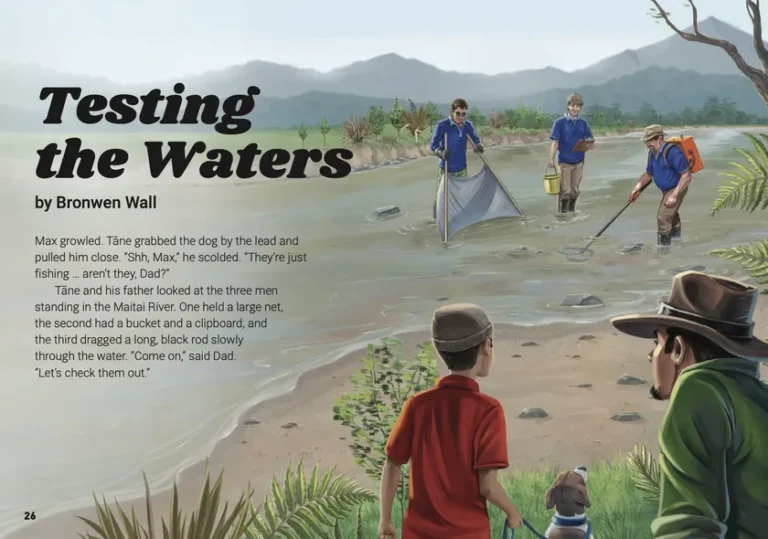
How clean is the water in your river? Scientists are testing the health of the Maitai River. Find out what data they collect and what can be done to make our rivers cleaner and healthier for everyone.
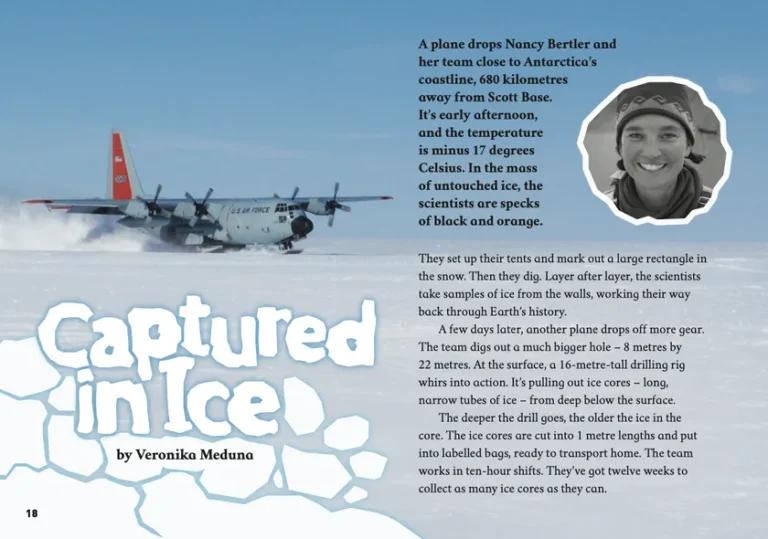
Nancy Bertler is a scientist who studies the ice. She’s been examining Antarctic ice cores to discover what Earth’s climate was like in the past – and how it might change in the future.
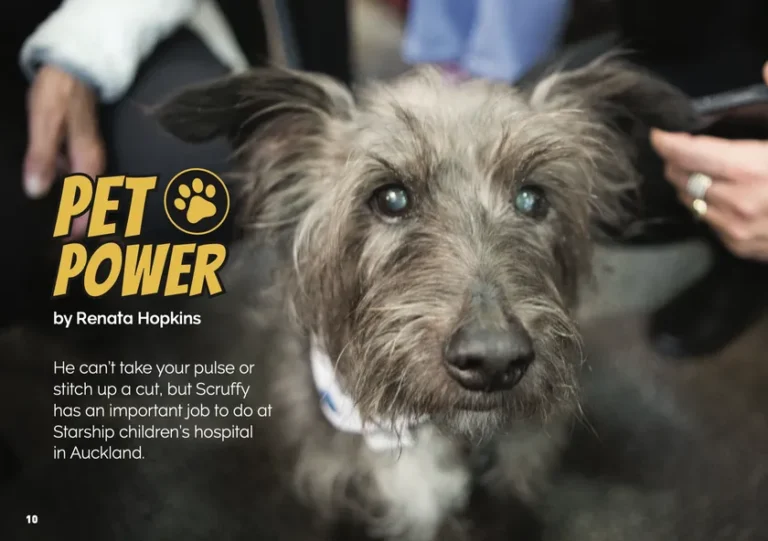
Humans and animals have a powerful bond. Some people think that this bond could have a positive effect on human health and behaviour. But what does the science say? Investigate the evidence for yourself.
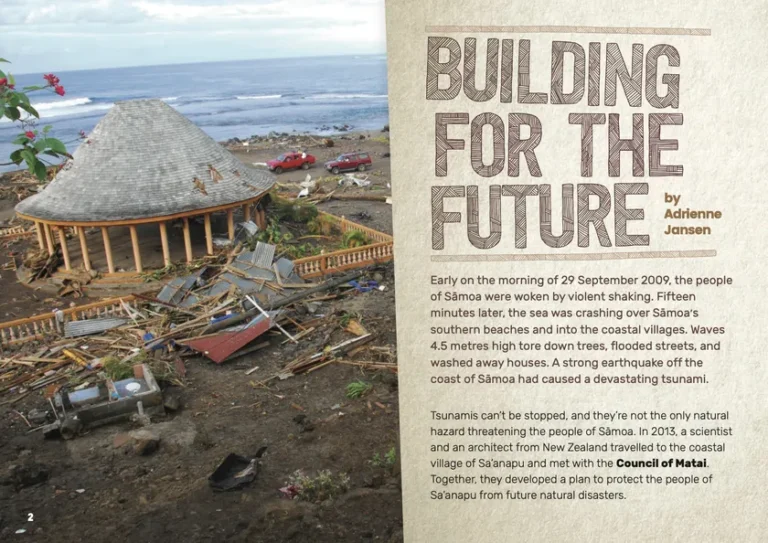
The Samoan village of Sa’anapu is under threat from tsunamis, cyclones, and rising sea levels. To protect their village, the Council of Matai are working with an architect and scientist from New Zealand. Together, they’re drawing on cultural, scientific, and technological knowledge to build a safer future for Sa’anapu.

This poem presents a set of humorous, unconventional instructions for assembling and maintaining a unique tent in the wilderness.

This story is about a girl named Atutahi who neglects her pet unicorn, Sparkles, after becoming obsessed with her latest hobby, spaceship racing
©Top Teaching Tasks – ©NZ MOE – ©The Crown | Copyright Info
 Top Teaching Tasks