Bouncing the Beat – Junior Journal 65 Level 2 2023
A poem conveying the lively movement of the Samoan sāsā dance.



A poem conveying the lively movement of the Samoan sāsā dance.

Instructions showing how to use split-pin paper fasteners to make a puppet with movable limbs.

An explanation by illustrator Ant Sang about how he conveys movement in his illustrations.

A report about tools that assist humans in tasks associated with movement.
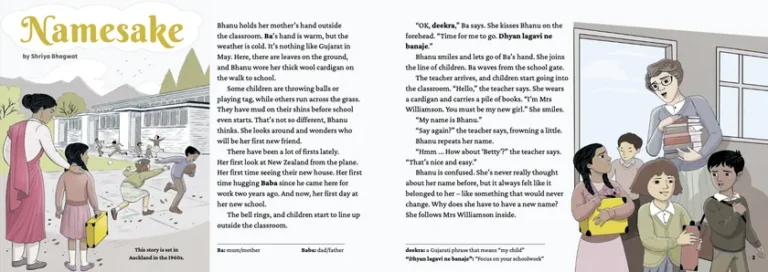
This fictional story looks at the experience of Bhanu, who has recently arrived from India, as she starts at a new school and stands up for her identity. Bhanu has recently arrived from India and is excited to start at her new school. When she arrives, her teacher gives her a new name! Bhanu is…
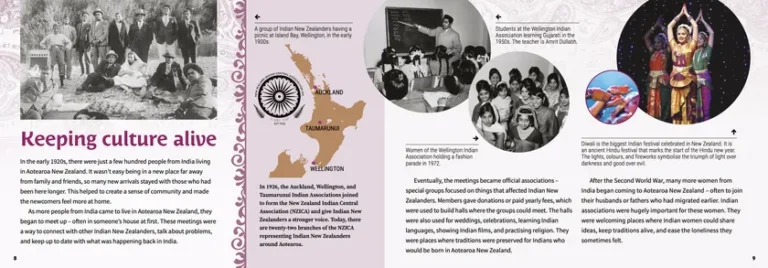
This short text describes how Indian New Zealanders have created cultural associations to help maintain their connections with their home country, provide support, and learn from each other. Cultural associations have been very important for Indian New Zealanders and their communities. This text looks at the formation of these associations and the support they provided,…
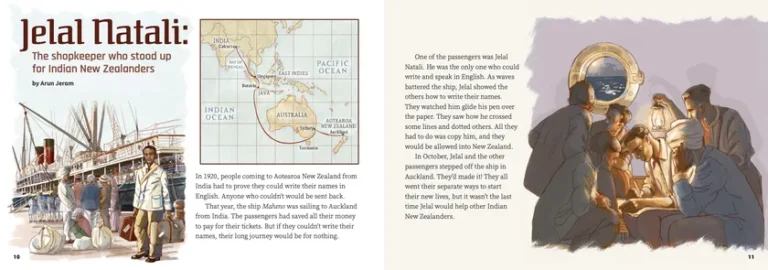
This text explores the tireless work of Jelal Natali to support and represent Indian New Zealanders. Jelal Natali was an Indian migrant to Aotearoa New Zealand in the 1920s. This biography explores some of the racism he encountered here and the ways he worked with others to counteract that racism and help both Indian New…

In this School Journal there are four articles (Estuaries; Kaitiaki of the Estuary; Saving the Lizards; and Taniwha), two stories (Tree Talk and Hukarere and Hine Tai), one interview (Protecting the Waterways), and one student writing (Harbour View).

I live near the sea, north of Auckland. Above my house, there is a small but welcoming hill. It has a wooden chair and a breathtaking view of the sparkling ocean.

Des Heke Kaiawha was a student at Maungatapu School in the 1980s. Since then, he has helped build knowledge of te ao Māori in the school. He spoke to Keri Welham about the waterways of Tauranga and his work to protect them. He spoke to Keri Welham about the waterways of Tauranga and his work…

This Junior Journal contains 3 articles (What is a Tree?; Tree Facts; Trees and Us), one story (The Sticky, Sticky Pine), one artwork (The Golden Bearing), and one activity (Leaf art).

When you put paper over a leaf and rub it with crayon, all the details of the leaf will show up on the paper. You can use leaf rubbings to create beautiful pictures. You can use leaf rubbings to create beautiful pictures.

This beautiful, life-sized golden tree was created by Aotearoa New Zealand artist Reuben Paterson (Ngāti Rangitihi, Ngāi Tūhoe, Tūhourangi, Scottish).
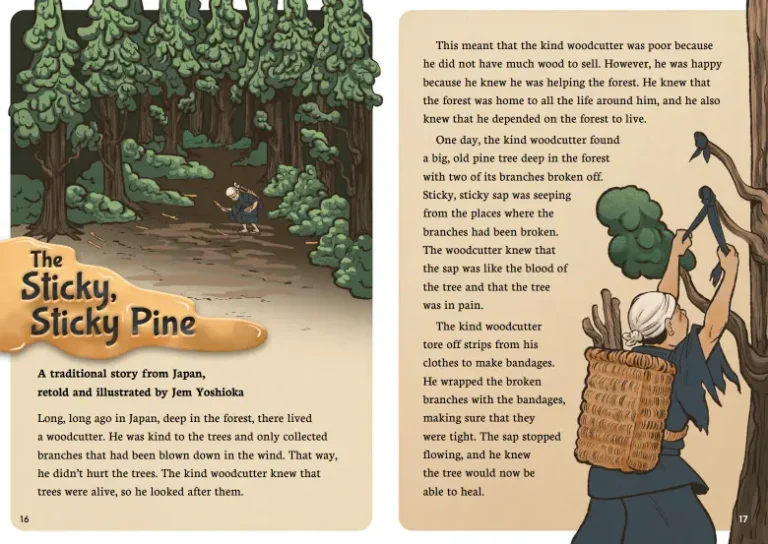
Long, long ago in Japan, deep in the forest, there lived a woodcutter. He was kind to the trees and only collected branches that had been blown down in the wind. That way, he didn’t hurt the trees. The kind woodcutter knew that trees were alive, so he looked after them.
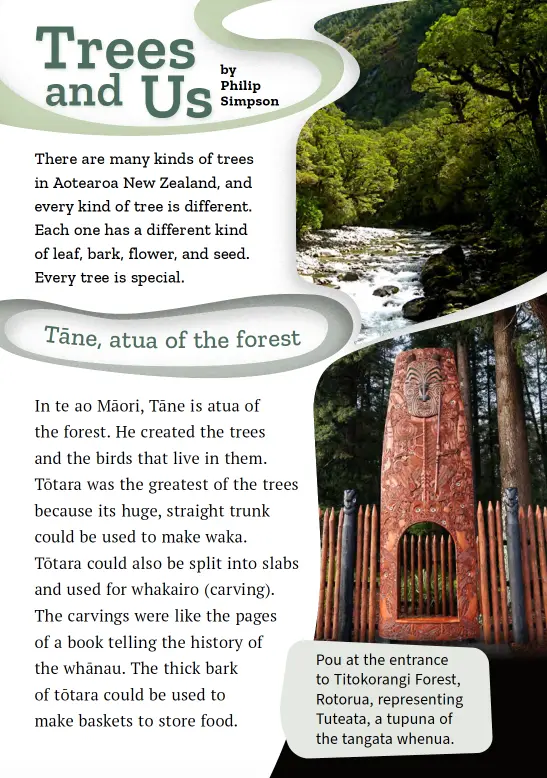
There are many kinds of trees in Aotearoa New Zealand, and every kind of tree is different. Each one has a different kind of leaf, bark, flower, and seed. Every tree is special.

Information about some endemic and native trees in Aotearoa New Zealand.

Can Hukarere see Hine Tai – the taniwha who lives in the rock pool?

In this story, two siblings who get lost in a forest have a dreamlike encounter where they transform into trees and learn how the forest communicates and feels about climate change.

Taniwha have a special relationship with Māori, who tell many stories about them. Taniwha have different roles – and one of these is as kaitiaki. Many taniwha live in or near lakes, rivers, or the sea and help to protect and keep these places safe.

In 2015, eighty native lizards were moved to Ngā Manu Nature Reserve because their homes were in the path of the new Transmission Gully motorway. The lizards stayed at Ngā Manu until new homes were made for them near the motorway.

Meet the students who are looking after their local estuary. Keywords: climate change, crabs, environment, estuary, habitats, kaitiaki, kaitiakitanga, Maungatapu, Ngā Pōtiki, Ngāti Hē, pāpaka, pollution, Rangataua Bay, tāhuna, Tauranga Moana

Estuaries are home to many kinds of birds, fish, and plants.

Long before the tūpuna of Māori settled in Aotearoa, people sailed across the Pacific Ocean using their knowledge of the stars and nature to find their way. One of those people was Hui Te Rangiora. Nearly 1,500 years ago, he made an amazing journey deep into Te Tai Uka a Pia (the Southern Ocean), where…

What do you do in your free time? Some people choose to be volunteers – people who like to help others. In this article, the author talks to some young volunteers to find out why they do it.

A tree is a type of plant. Grass is also a plant. So are vegetables. What makes a tree different from these other plants?

In this Junior Journal are three articles (Volunteers; Kūmara – Behind the Scenes; Settling In), one activity (Kūmara Wedges), one poem (One Jandal), and one play (Water Worries).

In the play “Water Worries,” a town faces a mysterious water shortage during a heatwave, leading various officials to blame global warming or infrastructure issues. The problem is ultimately solved when a dragon named Dora discovers that her dragon friends are accidentally damming the river by swimming in it all at once to cool down.

The poem uses the metaphor of a single, useless jandal and a car stuck in the sand to illustrate that while people can often manage alone, everyone eventually encounters challenges that require the support of others. It highlights how collective effort and the willingness of family and strangers to help can turn a difficult situation…

A recipe for Kūmara Wedges.

Inside this School Journal are five articles (Hui Te Rangiora – The Navigator; Oriori, Tō Mātou Wāhi – Our Place; Māui at Mahitahi and Out of the Wild), one poem (Piki Kōtuku), one student writing (My Poppa), and two stories (Hidden Talent; Best in Show).
©Top Teaching Tasks – ©NZ MOE – ©The Crown | Copyright Info
 Top Teaching Tasks