Getting Around – Junior Journal 68 Level 2 2024
There are so many ways of getting around – scooters, wheelchairs, bikes, trains, buses, cars, and even planes. Find out how some young people get from place to place.
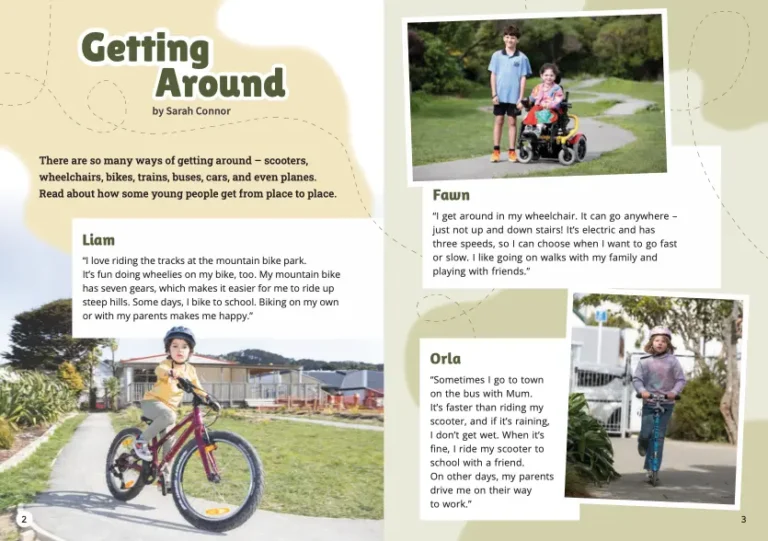
There are so many ways of getting around – scooters, wheelchairs, bikes, trains, buses, cars, and even planes. Find out how some young people get from place to place.
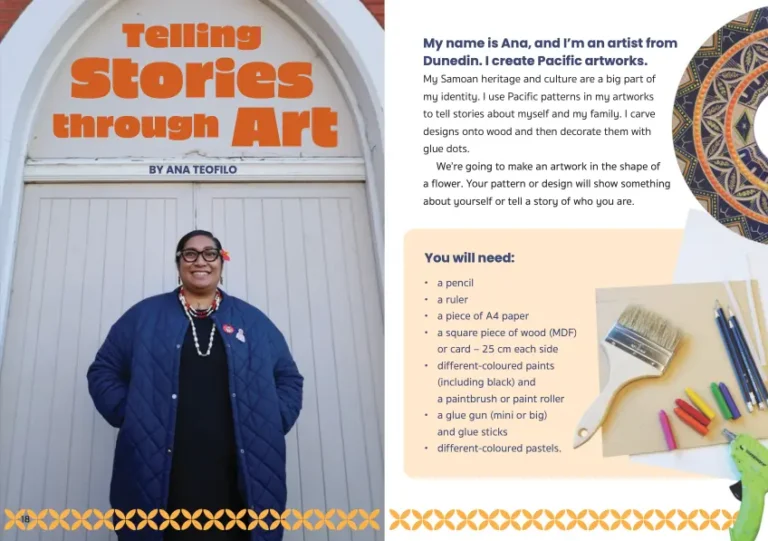
This activity shows students how to make an artwork that shows something about themselves.
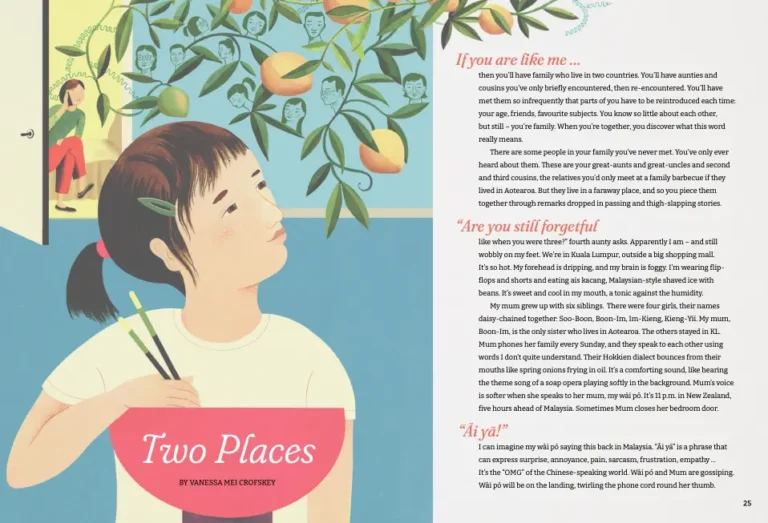
If you’re like me, you’ll have family that lives in two countries. You will have met them so infrequently that parts of you have to be reintroduced each time: your age, friends, and favourite subjects. You know so little about each other, but still, you’re family. When you’re together, you discover what this word really…
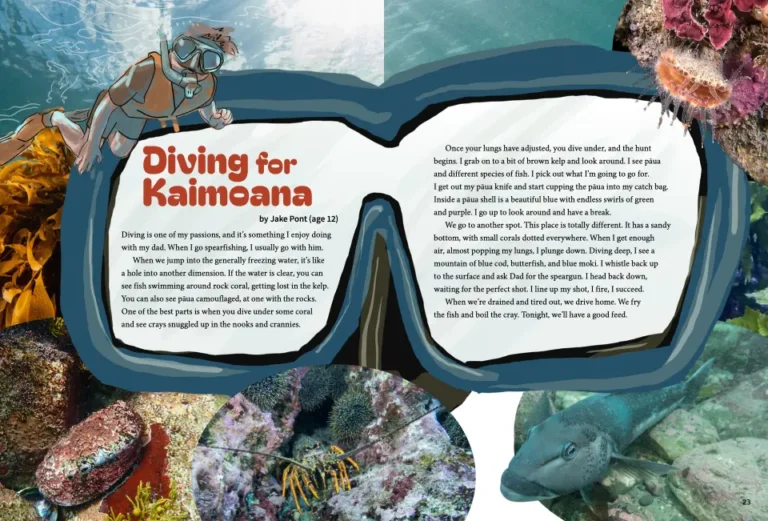
The writer describes his love of diving and his enjoyment of doing it with his father.
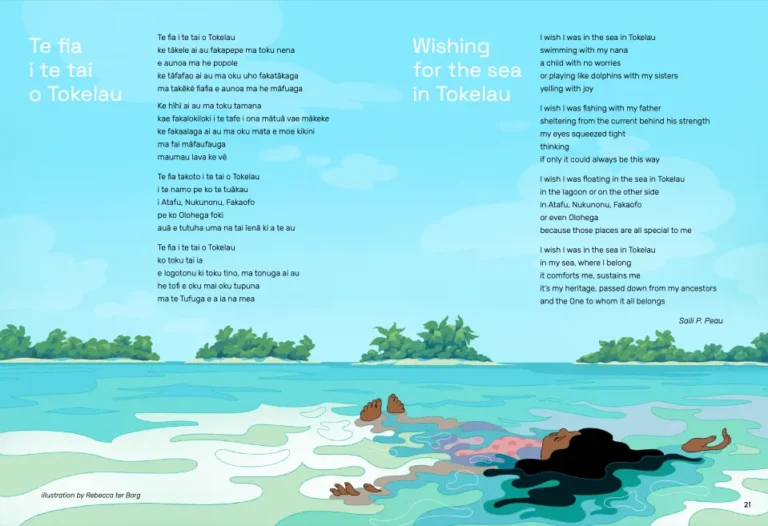
A poem in Tokelauan and English about the poet’s yearning for the sea in Tokelau.
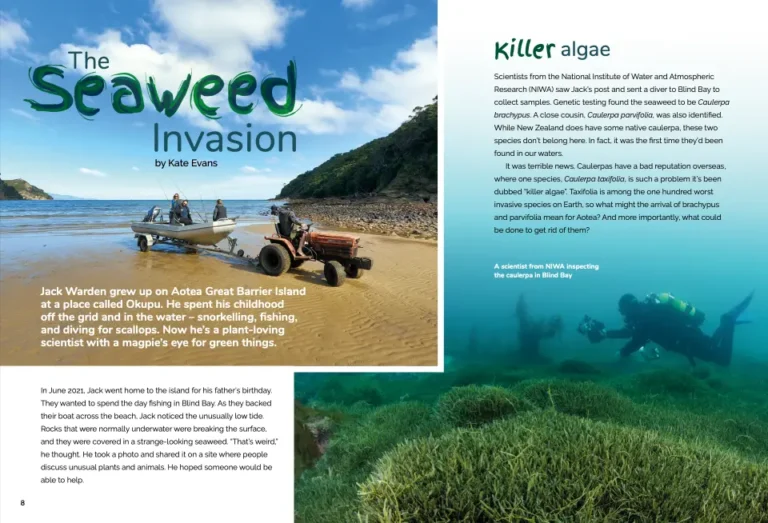
Caulerpa is a seaweed that smothers everything in its path—sea sponges, mussels, and scallops. It is a big problem on Aotea Great Barrier Island. Mana whenua and the government are working to stop the spread of one of the world’s most invasive seaweeds.
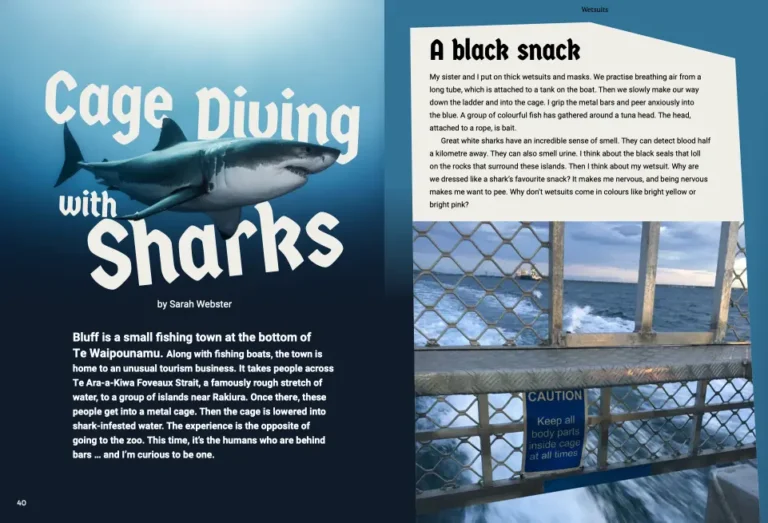
The author recounts an encounter with a great white during a cage-diving trip in Foveaux Strait. As well as challenging common narratives about sharks, the writer emphasises their importance as a keystone species essential for keeping marine ecosystems healthy. Keywords: apex predators, biodiversity, Bluff, cage diving, eco-tourism, extinction, food chain, Foveaux Strait, keystone species, ocean,…
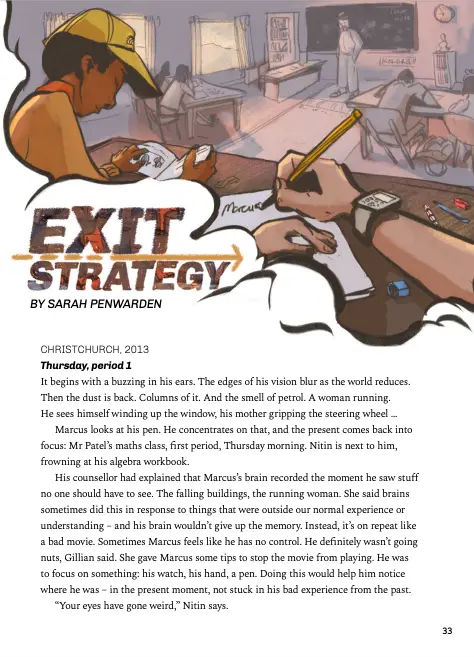
Marcus suffers from flashbacks after the Christchurch earthquakes. To deal with his anxiety, he takes comfort in the logic of maths and plans to become an engineer and build safer buildings. Marcus’s friends and teachers all offer support, and he also attends regular therapy sessions.
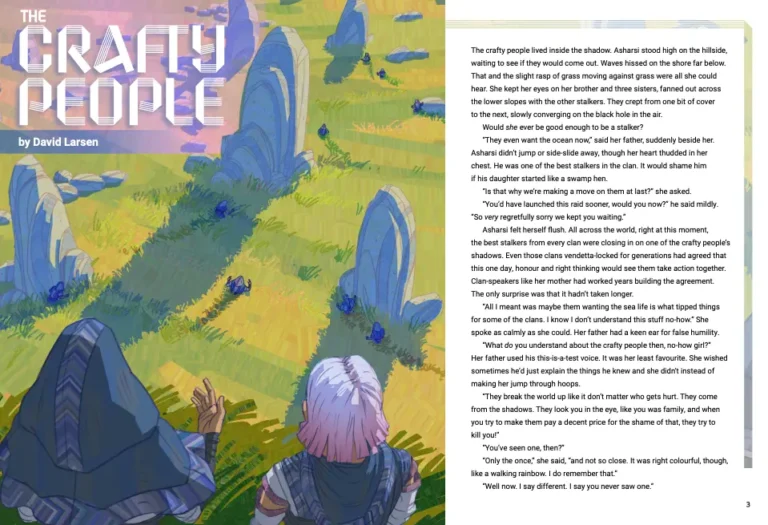
All her life, Asharsi’s clan have silently worried. The great project to heal the world is in danger because the crafty people are now everywhere. They have torn the world apart and used it to make things. And now they want the sea,
In this School Journal, there is one comic (The Matakite and the Mōkai), two stories (Chaos and Coconut Crabs), one student writing (Dear Nan-nan), two articles (Four Stories and Te Aro Pā), and one play (Ka Mau te Wehi!).
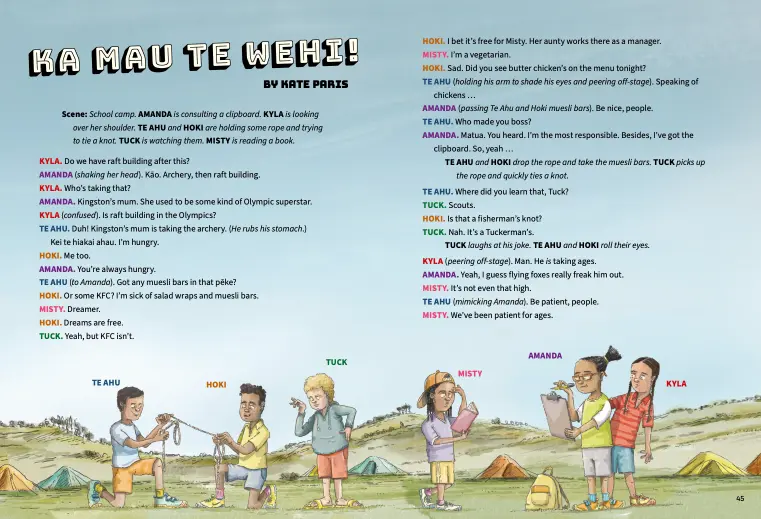
In this humorous sequel to “Mauri Mahi, Mauri Ora” (SJ L3 May 2021), the students are again waiting in a queue, this time at school camp.
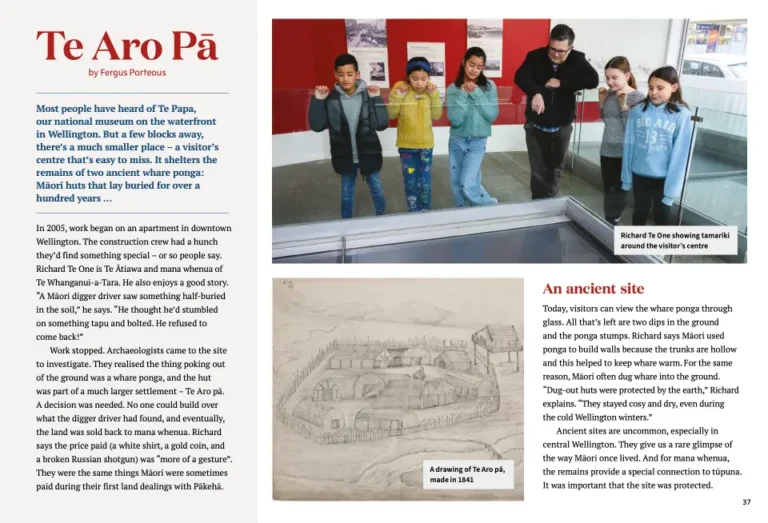
The remains of Te Aro Pā were discovered in the early 2000s in Wellington. This article explores the history of the pā and the iwi who lived there, as well as the impact of European settlers from the 1840s and the 1855 earthquake. Keywords: archaeologists, artefacts, colonisation, daylighting, earthquakes, history, Kupe, māra kai, pā, Pākehā,…
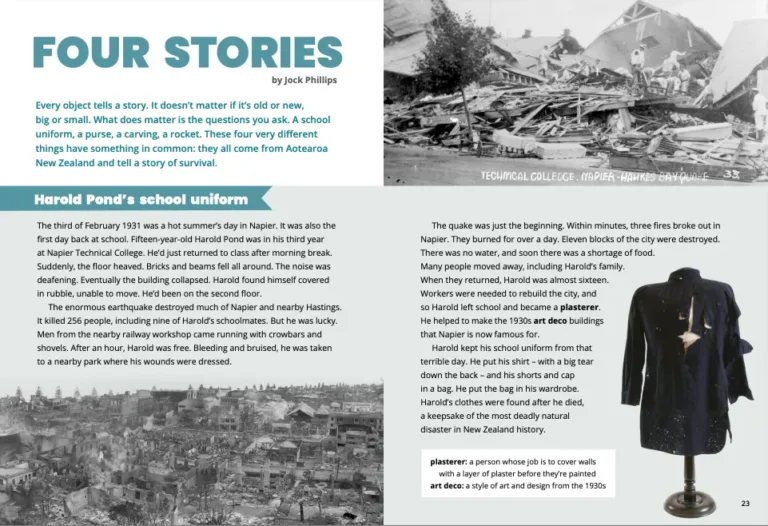
In this article, Jock Phillips shares what historians have learned about the past from four different objects. Each one tells a story about survival. Keywords: artefacts, Christchurch, discovery, Endeavour, Foveaux Strait, history, Joseph Banks, kurī, Monck’s, Cave, moa, Napier earthquake, natural disasters, Pacific, rockets, sailing ships, sealers, sealing, sealskins, shipwrecks, Solander Island, storytelling, survival, taonga,…
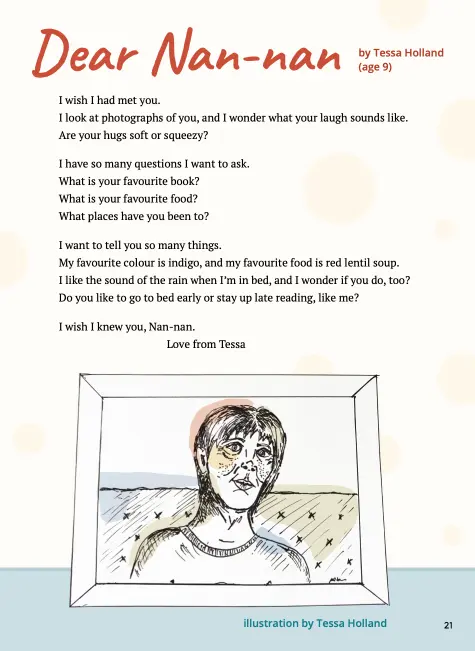
The writer wonders what her nan-nan was like and wishes she had met her.
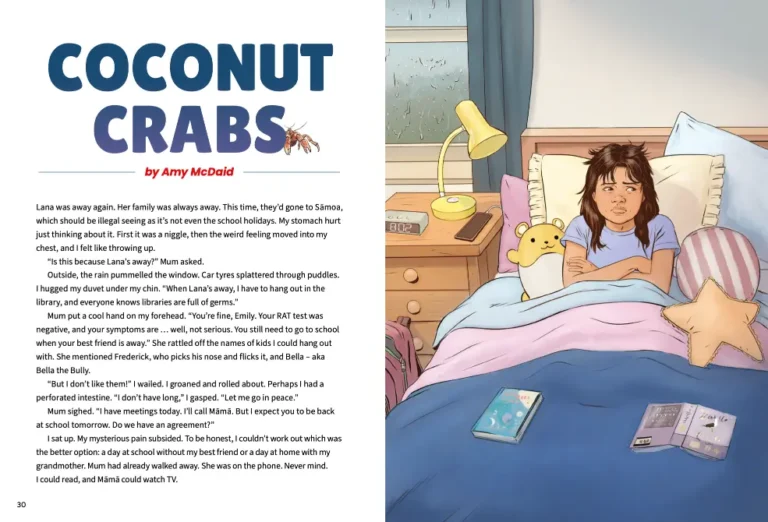
A sequel to “Fresh” (SJ L3 June 2023), the relationship between Emily and Māmā deepens after Emily stays home from school and eventually confides in her grandmother the reason why.
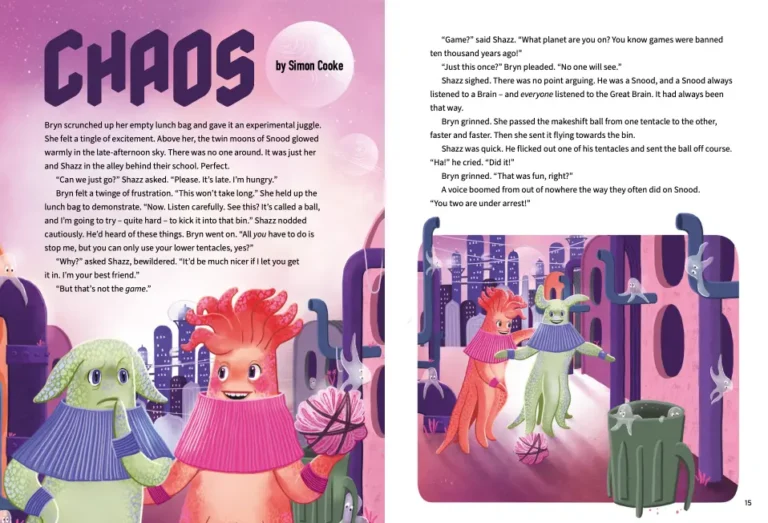
Bryn and Shazz live on a planet inhabited by Brains and Snoods. After breaking a fundamental law by playing a game, they are sent to Earth to observe humans playing sports.
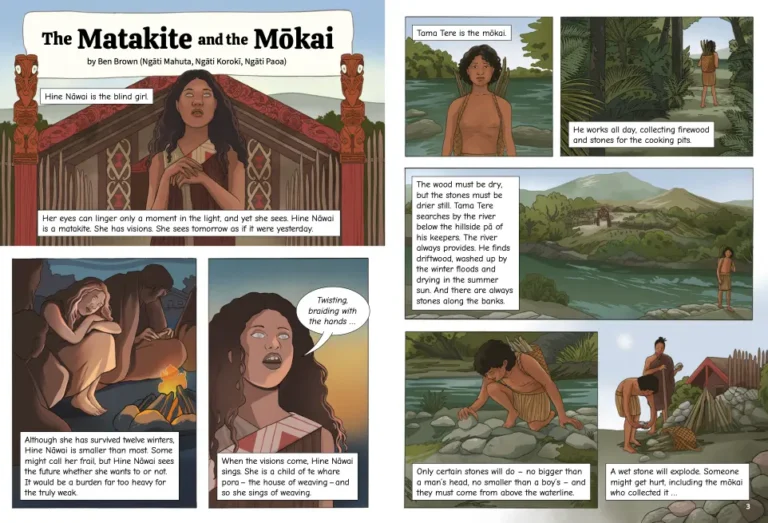
Set in pre-European times, this comic explores the relationship between a matakite and a mōkai.
The narrator’s grandparents are arriving from India for the first time since the pandemic. The family has been busy planning a series of surprises, but the real surprise occurs at the airport.
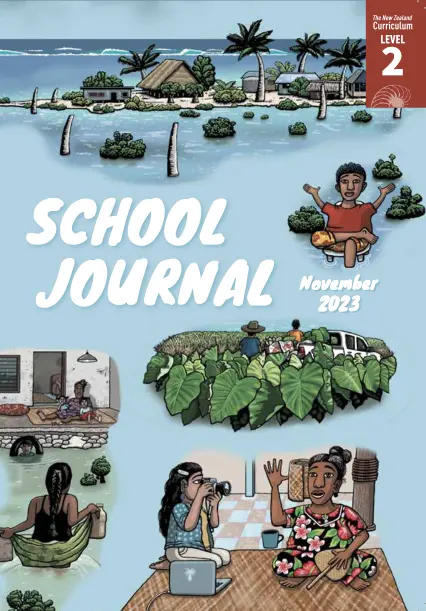
Inside this School Journal are four articles (The Problem With Wallabies; Being Myself; Giving a Green Gift, and The Future of Growing Kai), two stories (Surprise! and Lockdown), one poem (Time Capsule) and one example of student writing (Tiny Dragon). Five texts in this issue share the theme of sustainability.
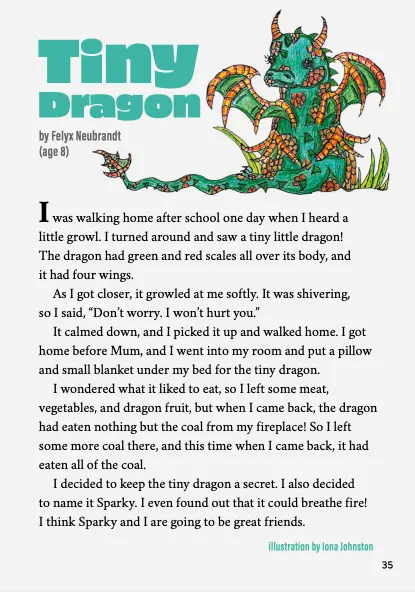
A child discovers a dragon on the way home from school.
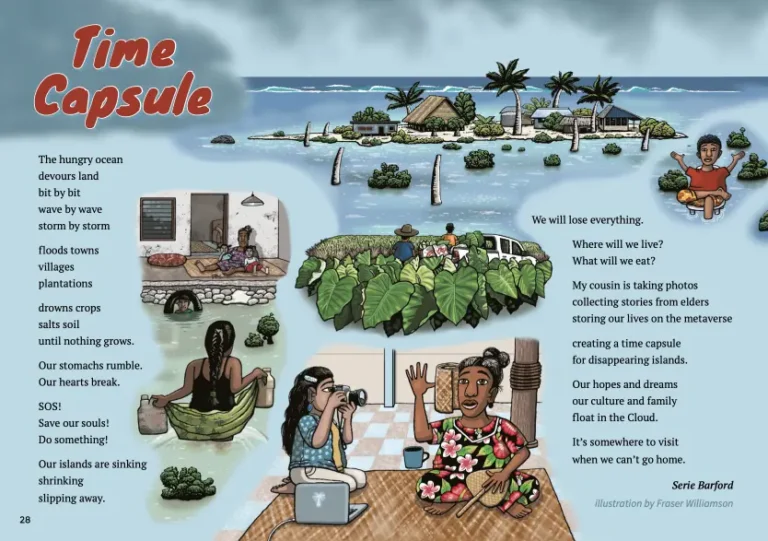
A poem that expresses the impacts of climate change in the Pacific.
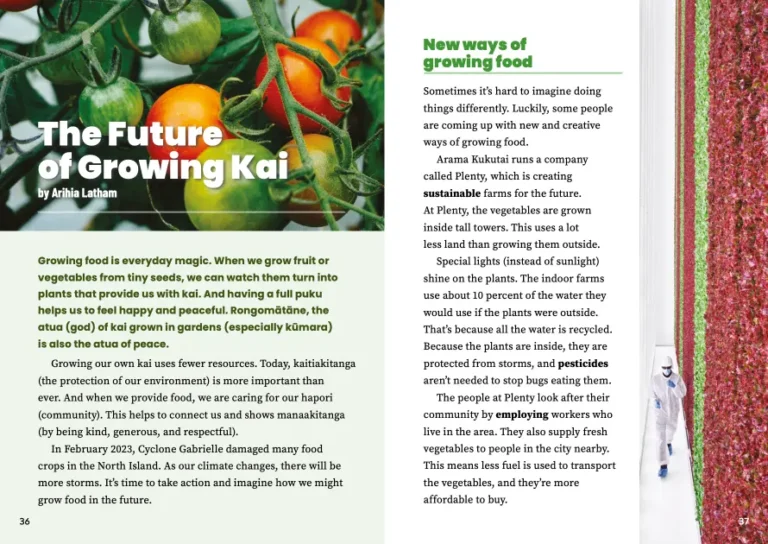
As our climate changes, we need to take action about how we grow food. This article explores new, traditional, and innovative ways of growing food. Keywords: climate change, compost, environment, Enviroschools, farms, food, gardening, kai, kaitiakitanga, lunar calendar, manaakitanga, māra kai, maramataka, organic, pesticides, pests, plants, Rongomātāne, sustainability, whānau, worm farm
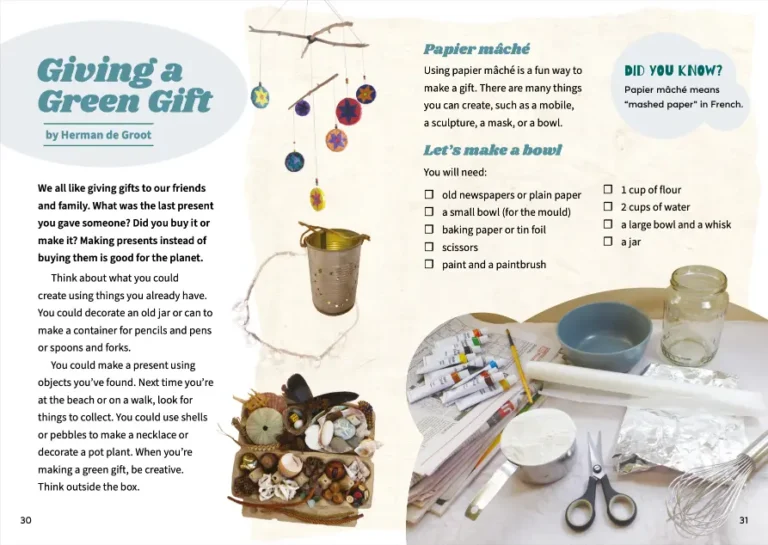
This procedure explains how to be creative and make a sustainable gift.
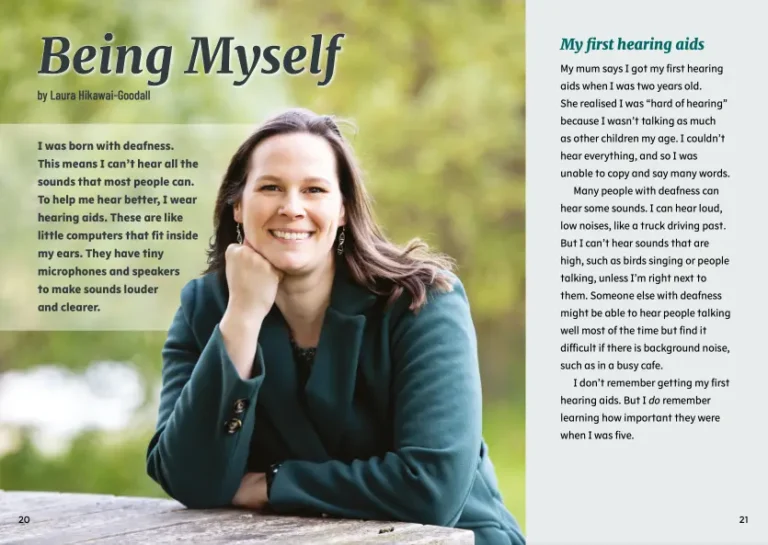
Laura Goodall describes the challenges of growing up hard of hearing and how it has made her the person she is today.
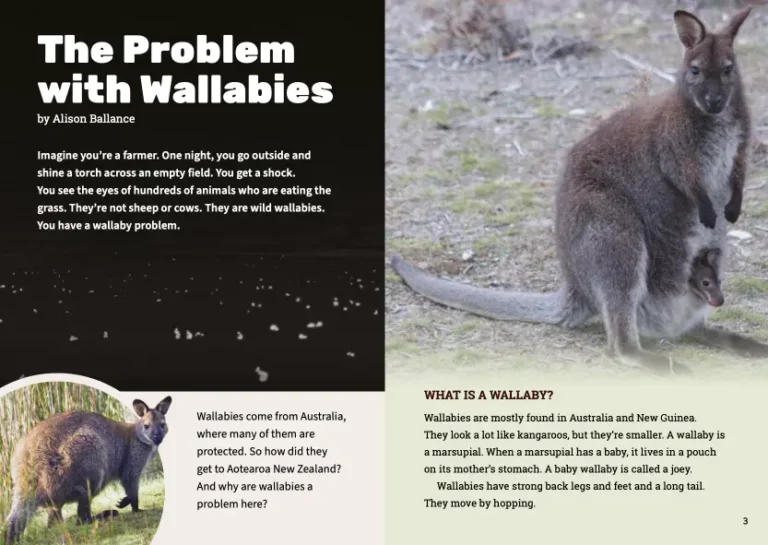
This article examines why wallabies were introduced to New Zealand, why they have become a pest here, and the efforts being made to eradicate them.
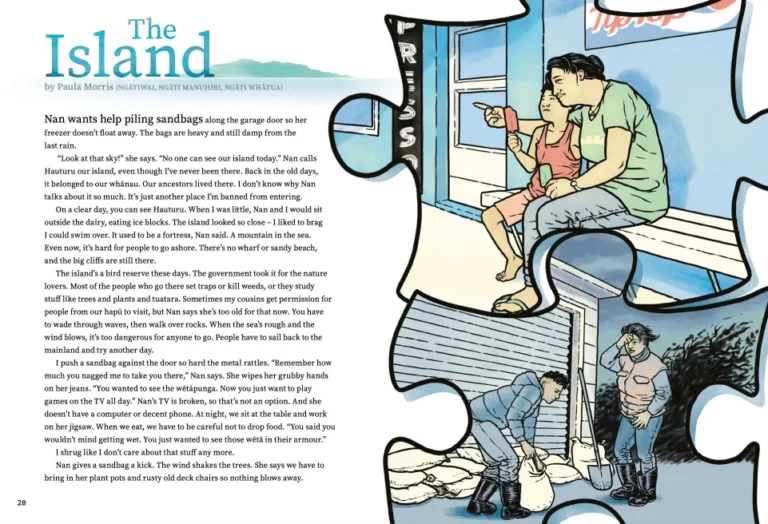
Nan has always told stories about Hauturu before it was taken away from their ancestors. The narrator used to nag Nan to take him to the island. Now he doesn’t “care about that stuff any more”. But during a storm, “I want to see that stone and the wētāpunga and the birds. I want to…
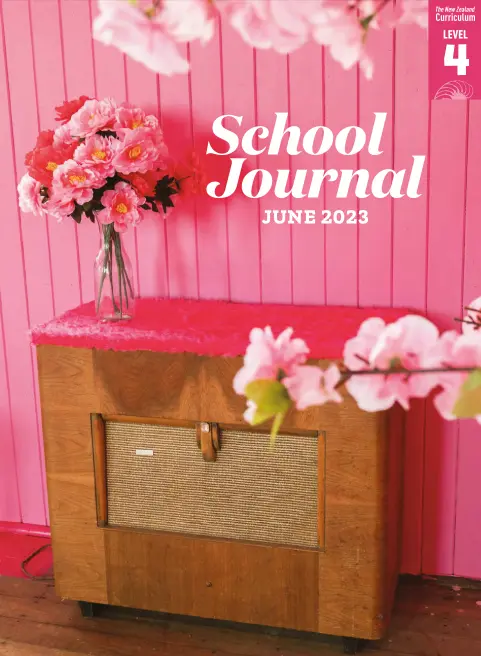
Inside this school journal are three stories (Pākehā Tapu Day; Paper Tiger; The Stunt Man and the Geologist), one poem (Tokotoko), one student writing (Keith), one essay (Beyond Imagination), and two articles (Valley of the Whales; Silk Robes and Big Hats).
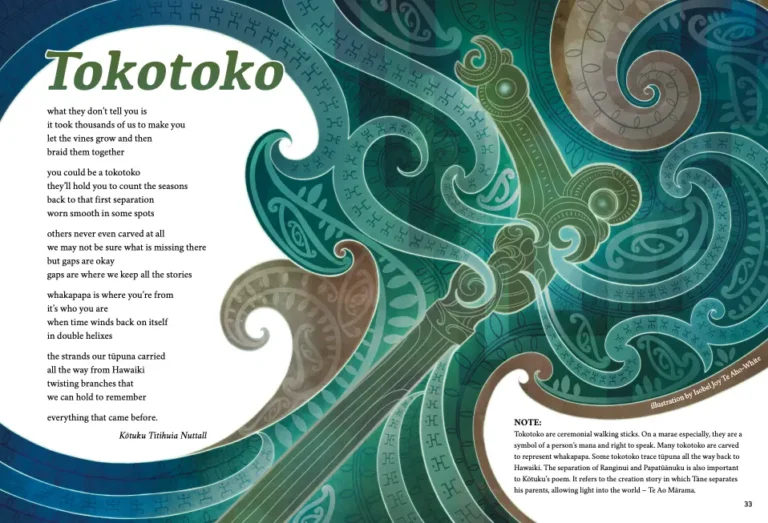
This poem uses tokotoko to express ideas of whakapapa, tūpuna, family history, and belonging.
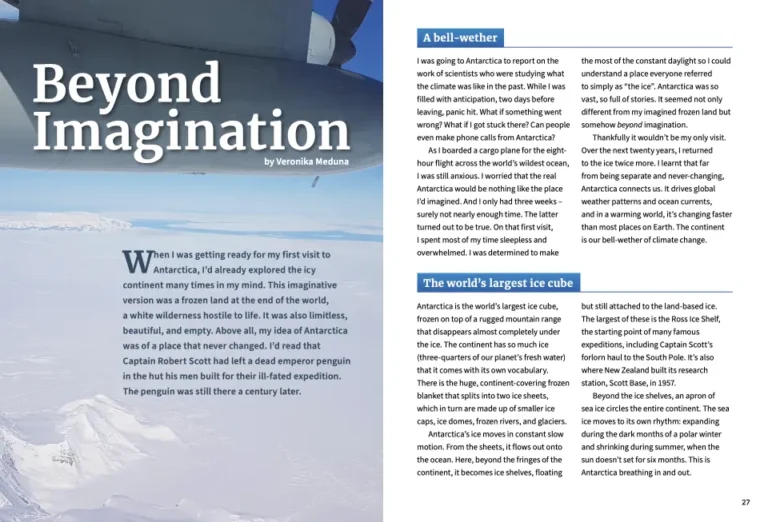
The author recounts her visits to Antarctica. I learnt that far from being separate and never-changing, Antarctica connects us. It drives global weather patterns and ocean currents, and in a warming world, it’s changing faster than most places on Earth. Keywords: Antarctica, Captain Robert Scott, climate change, endangered species, environment, geology, glaciers, greenhouse gases, history,…
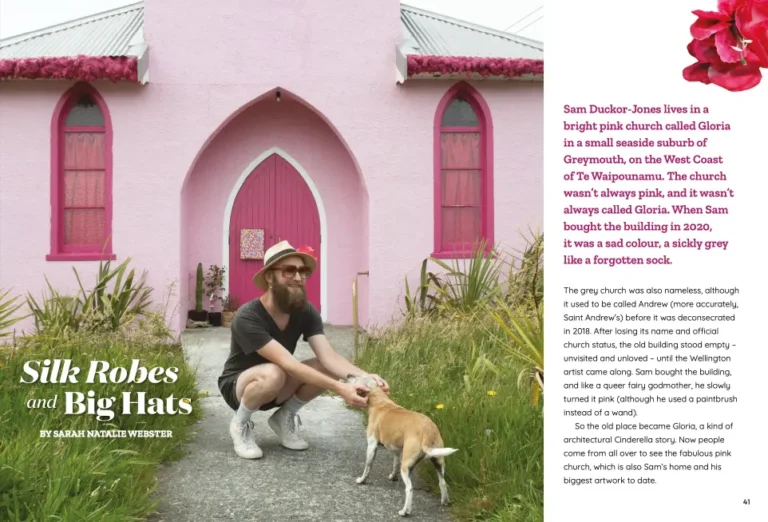
This article explores the work of multi-disciplinary artist Sam Duckor-Jones. Sam’s work asks us to imagine a pinker, joyful, more inclusive world – one where we’re all free to put on silk robes and big hats and be absolutely, unapologetically ourselves.
©Top Teaching Tasks – ©NZ MOE – ©The Crown | Copyright Info
 Top Teaching Tasks